
EXERCISE 1 – EBP Vs. Citizens’ Budget
Background: Ghana’s 2023 EBP comprised six documents, featured in the clickable screenshot below:
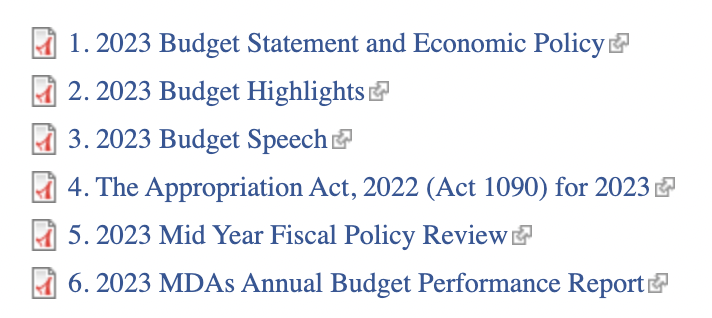
While the 2023 Citizen’s Budget, not featured above, was 43 pages, the Budget Statement and Economic Policy document was 332 pages. Therein lies the trade-off between simplicity and level of required detail.
1.1 Below are excerpts on public debt management from both the Citizens’ Budget and the Budget Statement.
Excerpt from the Citizens’ Budget:
“As of September 2022, Ghana’s public debt stood at 75.9% of GDP. This increase is largely due to rising interest costs and the depreciation of the cedi. The government plans to reduce the debt through measures such as fiscal consolidation and improving revenue collection. These actions are expected to help manage the debt sustainably.”
Excerpt from the Budget Statement:
“As of the end of September 2022, the total public debt stock amounted to GH¢467,371.32 million (US$48,871.34 million), representing 75.9 percent of GDP. The breakdown includes domestic debt of GH¢195,657.61 million, which equates to 31.8 percent of GDP, and external debt of GH¢271,713.71 million, representing 44.1 percent of GDP. The primary drivers of the rising debt stock include the rising cost of domestic borrowing, depreciation of the cedi, and elevated interest costs on external debt. As part of the government’s fiscal consolidation efforts, measures are being implemented to reduce the public debt burden, including increasing tax revenue, reducing non-essential imports, and expanding local production of import substitutes. These strategies are integral to the government’s overall debt sustainability framework.”
Answer the following questions:
Upload your answers in the comment box provided below
Your answers will be shared with only the course facilitator via [email protected]
- How do both documents help different audiences understand public debt management.
- Which level of detail is right for your budget work and why?
Now share your impressions and contributions with other learners in the comment section provided
-
Oui,
Une version plus simple et moins technique des dispositions contenues dans le budget de l’Etat est important car permet d’une part, d’expliquer la loi de finances au grand public et d’autre part, de lui faciliter l’accessibilité à l’information budgétaire.
Favorise une bonne compréhension de la répartition de compréhension de la dette intérieure, du déficit budgétaire
(i) mettre à la disposition des citoyens les informations contenues dans la loi de finances en tant qu’instrument de transparence financière ; (ii) permettre l’appropriation du budget de l’Etat ; (iii) susciter chez les citoyens le désir de participer activement à la gestion de la chose publique et de veiller à la bonne exécution du budget de l’Etat. -
The following people are my take towards the questions above…
How do both documents help different audiences understand public debt management?
1. Citizens’ Budget:
• Audience: The general public, including non-experts and everyday citizens.
• Purpose: Simplifies complex financial information into more accessible language.
• Content: Provides a high-level overview of the public debt situation, explaining key concepts such as the debt-to-GDP ratio and the main factors contributing to the debt increase (interest costs and currency depreciation). It outlines the government’s intended actions for debt reduction in straightforward terms (fiscal consolidation and revenue improvement).
• Usefulness: Helps citizens understand the basic state of public debt and the government’s planned measures to manage it, fostering greater public awareness and engagement.
Budget Statement:
• Audience: Policy makers, economists, financial analysts, and stakeholders involved in budget planning and oversight.
• Purpose: Offers a detailed, precise account of the public debt, including specific figures and percentages.
• Content: Breaks down the debt into domestic and external components, provides detailed explanations of the factors driving the debt increase, and outlines comprehensive strategies for debt management (such as increasing tax revenue, reducing non-essential imports, and expanding local production).
• Usefulness: Equips policymakers and analysts with the detailed information required to scrutinize the government’s debt management strategies and make informed decisions about fiscal policies.
2. Which level of detail is right for your budget work and why:
For my budget work, the level of detail provided in the Budget Statement is more appropriate. Here’s why:
• In-Depth Analysis: My work involves detailed analysis and understanding of the financial situation, requiring specific figures and breakdowns of domestic and external debt.
• Strategic Planning: Detailed information on the causes of debt increase and the government’s strategies for addressing it are crucial for strategic planning and developing targeted interventions.
• Policy Recommendations: Accurate data and comprehensive explanations enable me to make informed policy recommendations and contribute to discussions on fiscal policies.
Having access to the detailed information in the Budget Statement allows for thorough analysis, better-informed decisions, and effective advocacy for sound fiscal policies. -
The following highlights above are my take towards the questions asked…
-
The Excerpt from the Citizens’ Budget is fine for me and my audience. It is simpler and not loaded with figures nd percentages that put non-experts off at first sight. But it can be made even more when using infographics to summarize this information and enable one to understand this paragraph by looking at it first time
-
Comment les deux documents fournissent-ils différents publics pour comprendre la gestion de la dette publique ?
Les deux documents annoncent les mêmes information en terme de niveau d’endettement du Ghana avec le même pourcentage de 75,9 % du PIB
Mais le deuxième donnent plus de détails avec les chiffres exact des dettes intérieures et extérieures et les raison de ce niveau d’endettement
Quel niveau de détail convient le mieux à votre budget
À la fin du mois de septembre 2022, l’encours total de la dette publique s’élevait à 467 371,32 millions GH¢ (48 871,34 millions de dollars US), soit 75,9 % du PIB. La répartition comprend une dette intérieure de 195 657,61 millions de GH¢, ce qui équivaut à 31,8 % du PIB, et une dette extérieure de 271 713,71 millions de GH¢, soit 44,1 % du PIB. Les principaux facteurs de l’augmentation de l’encours de la dette sont l’augmentation du coût de l’emprunt intérieur, la dépréciation du cedi et les coûts d’intérêt élevés sur la dette extérieure. Dans le cadre des efforts d’assainissement budgétaire du gouvernement, des mesures sont mises en œuvre pour réduire le fardeau de la dette publique, notamment l’augmentation des recettes fiscales, la réduction des importations non essentielles et l’expansion de la production locale de substituts aux importations. Ces stratégies font partie intégrante du cadre global de viabilité de la dette du gouvernement
et pourquoi ?
Il donne les raison du niveau d’endettement et les mesures envisager pour y faire face
Partagez maintenant vos impressions et vos contributions avec d’autres apprenants dans la section des commentaires fournie
Nous pensons que ces informations sont capitales pour les citoyens et les groupes organisés pour mener un plaidoyer en faveurs des citoyens et les générations futures en vue de voir comment éviter le payement de la dette ne puisse pas compromettre les biens être sociale et l’avenir ainsi que la stabilité du pays pour des citoyens actuel et futurs du Ghana -
The Citizens’ budget simplifies the public debt management information; as a result, it is understood by both the literate and illiterate or the general public. The Executive Budget Proposal is meant to be understood and used by the legislature and budget analysts.
-
Although both the Executive Budget Proposal and the Citizens’ budget are important documents, if they are utilized effectively, they promote transparency and accountability The Citizens’ budget is the preferable budget document for the work we do at the Center for Transparency and Accountability in Liberia because our advocacy cut across every sector of the economy – promoting inclusive participation of citizens including the marginalized group (Women, youth, people with disabilities, and the uneducated population).
-
EBP helps create clear, data-driven strategies to manage public debt, allowing policymakers to make informed decisions about borrowing, repayment schedules, and fiscal policies.
While EBP is often technical, the data and research used to inform debt management decisions can be translated into understandable reports and analyses that help the public grasp the rationale behind fiscal policies.The Citizen’s Budget breaks down complex fiscal information, including public debt, in a manner that is easy to understand. It explains where government revenue comes from and how it is spent, with a focus on the impact of public debt on services and future generations.
By promoting transparency, the Citizen’s Budget fosters an understanding of the national debt’s size, structure, and impact. It helps create a conversation about fiscal responsibility, as the public can see how much is spent on interest, debt repayment, or other areas impacted by borrowing. -
How do both documents help different audience understand public debt management?
Answer
Both documents portray transparency but the Citizens’ Budget as the name implies is explicit and well formulated and can be understood even by the unlearned.
This in itself will help CSO in their engagement with the community people before government budget approval hit the ground running.Which issue of detail is right for your budget work and why?
Answer
– indepth analysis provides understanding of the financial situation
– strategic planning
– policy discussions -
Can you find an example in which the additional detail provided in the budget statement is helpful for your budget work? How is it helpful?
Answer
I am thrilled by both examples of the budgets and therefore left with the opinion that the issues captured speak to both documents.Can you find an example in which the simplicity of the Citizens’Budget is preferred over the more detailed budget statement.
Answers
I do not envisage any. -
The simplicity levels are different. This is to ensure each audience is positioned at specific vantage point of understanding.
-
Les deux documents présentent les données sur la dette publique du Ghana, le budget citoyen présente cette information de façon simple et accessible à tout citoyen tandis que l’extrait budgétaire donne la même information mais avec beaucoup plus de détails.
Les OSC n’étant pas des experts alors le budget citoyen convient mieux aux travaux des OSC. Le budget citoyen selon les principes de IBP/GIFT sont élaborés pour faciliter la compréhension des documents budgétaires aux citoyens, aux OSC et non experts des finances publiques -
Citizen Budget: The information provided is very general focusing on key points. The language is simplified, clear, and concise for easy understanding, aiming to inform and engage citizens and the general public. It only provides highlights of broad strategies on fiscal consolidation and revenue collection.
Budget document: Language is technical, detailed, and data-driven for a specialized audience. It provides in-depth breakdown of debt composition for both domestic and external debt. It is meant for policy makers, economists, CSOs and financial professionals. It provides specified actions like increasing tax revenue, reducing non-essential imports, and expanding local production.
Which level of details is relevant for our work and why?
Citizens’ Budget: Helps CSOs engage better with citizens since it makes budget information accessible to the average Kenyan promoting inclusivity, transparency, and public participation in governance.
Budget Statement: Provides comprehensive details for CSOs to analyze and effectively engage policy makers and stakeholders and advocate for better budget policies. -
Ces documents permettent de comprendre le budget exécutif pour le grand public .Le budget citoyen vient simplifier la compréhension de budget exécutif et rendre les informations financières accessibles .
-
Example where the additional detail in the Budget Statement is helpful:
Debt Composition Breakdown: The Budget Statement specifies the total debt stock, separating it into domestic (GH¢195,657.61 million, 31.8% of GDP) and external debt (GH¢271,713.71 million, 44.1% of GDP).
Why Helpful: This level of detail is critical for my budget work, as it enables a deeper analysis of debt sustainability. Understanding the proportions of domestic vs. external debt helps assess risks such as currency fluctuations or interest rate changes and informs targeted advocacy on public debt management reforms.
Example where the simplicity of the Citizens’ Budget is preferred:Debt-to-GDP Ratio and Strategies: The Citizens’ Budget highlights the debt-to-GDP ratio (75.9%) and broadly outlines measures like fiscal consolidation and revenue collection without technical jargon.
Why Preferred: This simplicity is more effective for engaging the general public, especially those unfamiliar with technical financial terms. It focuses on relatable concerns (e.g., government plans to reduce debt) without overwhelming the audience, making it ideal for civic education and raising public awareness about fiscal challenges.


1.2 Perusing the contents of both budget documents:
- Can you find an example in which the additional detail provided in the Budget Statement is helpful for your budget work? How is it helpful?
- Can you find an example in which the simplicity of the Citizens’ Budget is preferred over the more detailed Budget statement? Explain your answer.
-
Oui,
Une version plus simple et moins technique des dispositions contenues dans le budget de l’Etat est important car permet d’une part, d’expliquer la loi de finances au grand public et d’autre part, de lui faciliter l’accessibilité à l’information budgétaire.
Favorise une bonne compréhension de la répartition de compréhension de la dette intérieure, du déficit budgétaire
(i) mettre à la disposition des citoyens les informations contenues dans la loi de finances en tant qu’instrument de transparence financière ; (ii) permettre l’appropriation du budget de l’Etat ; (iii) susciter chez les citoyens le désir de participer activement à la gestion de la chose publique et de veiller à la bonne exécution du budget de l’Etat. -
The following people are my take towards the questions above…
How do both documents help different audiences understand public debt management?
1. Citizens’ Budget:
• Audience: The general public, including non-experts and everyday citizens.
• Purpose: Simplifies complex financial information into more accessible language.
• Content: Provides a high-level overview of the public debt situation, explaining key concepts such as the debt-to-GDP ratio and the main factors contributing to the debt increase (interest costs and currency depreciation). It outlines the government’s intended actions for debt reduction in straightforward terms (fiscal consolidation and revenue improvement).
• Usefulness: Helps citizens understand the basic state of public debt and the government’s planned measures to manage it, fostering greater public awareness and engagement.
Budget Statement:
• Audience: Policy makers, economists, financial analysts, and stakeholders involved in budget planning and oversight.
• Purpose: Offers a detailed, precise account of the public debt, including specific figures and percentages.
• Content: Breaks down the debt into domestic and external components, provides detailed explanations of the factors driving the debt increase, and outlines comprehensive strategies for debt management (such as increasing tax revenue, reducing non-essential imports, and expanding local production).
• Usefulness: Equips policymakers and analysts with the detailed information required to scrutinize the government’s debt management strategies and make informed decisions about fiscal policies.
2. Which level of detail is right for your budget work and why:
For my budget work, the level of detail provided in the Budget Statement is more appropriate. Here’s why:
• In-Depth Analysis: My work involves detailed analysis and understanding of the financial situation, requiring specific figures and breakdowns of domestic and external debt.
• Strategic Planning: Detailed information on the causes of debt increase and the government’s strategies for addressing it are crucial for strategic planning and developing targeted interventions.
• Policy Recommendations: Accurate data and comprehensive explanations enable me to make informed policy recommendations and contribute to discussions on fiscal policies.
Having access to the detailed information in the Budget Statement allows for thorough analysis, better-informed decisions, and effective advocacy for sound fiscal policies. -
The following highlights above are my take towards the questions asked…
-
The Excerpt from the Citizens’ Budget is fine for me and my audience. It is simpler and not loaded with figures nd percentages that put non-experts off at first sight. But it can be made even more when using infographics to summarize this information and enable one to understand this paragraph by looking at it first time
-
Comment les deux documents fournissent-ils différents publics pour comprendre la gestion de la dette publique ?
Les deux documents annoncent les mêmes information en terme de niveau d’endettement du Ghana avec le même pourcentage de 75,9 % du PIB
Mais le deuxième donnent plus de détails avec les chiffres exact des dettes intérieures et extérieures et les raison de ce niveau d’endettement
Quel niveau de détail convient le mieux à votre budget
À la fin du mois de septembre 2022, l’encours total de la dette publique s’élevait à 467 371,32 millions GH¢ (48 871,34 millions de dollars US), soit 75,9 % du PIB. La répartition comprend une dette intérieure de 195 657,61 millions de GH¢, ce qui équivaut à 31,8 % du PIB, et une dette extérieure de 271 713,71 millions de GH¢, soit 44,1 % du PIB. Les principaux facteurs de l’augmentation de l’encours de la dette sont l’augmentation du coût de l’emprunt intérieur, la dépréciation du cedi et les coûts d’intérêt élevés sur la dette extérieure. Dans le cadre des efforts d’assainissement budgétaire du gouvernement, des mesures sont mises en œuvre pour réduire le fardeau de la dette publique, notamment l’augmentation des recettes fiscales, la réduction des importations non essentielles et l’expansion de la production locale de substituts aux importations. Ces stratégies font partie intégrante du cadre global de viabilité de la dette du gouvernement
et pourquoi ?
Il donne les raison du niveau d’endettement et les mesures envisager pour y faire face
Partagez maintenant vos impressions et vos contributions avec d’autres apprenants dans la section des commentaires fournie
Nous pensons que ces informations sont capitales pour les citoyens et les groupes organisés pour mener un plaidoyer en faveurs des citoyens et les générations futures en vue de voir comment éviter le payement de la dette ne puisse pas compromettre les biens être sociale et l’avenir ainsi que la stabilité du pays pour des citoyens actuel et futurs du Ghana -
The Citizens’ budget simplifies the public debt management information; as a result, it is understood by both the literate and illiterate or the general public. The Executive Budget Proposal is meant to be understood and used by the legislature and budget analysts.
-
Although both the Executive Budget Proposal and the Citizens’ budget are important documents, if they are utilized effectively, they promote transparency and accountability The Citizens’ budget is the preferable budget document for the work we do at the Center for Transparency and Accountability in Liberia because our advocacy cut across every sector of the economy – promoting inclusive participation of citizens including the marginalized group (Women, youth, people with disabilities, and the uneducated population).
-
EBP helps create clear, data-driven strategies to manage public debt, allowing policymakers to make informed decisions about borrowing, repayment schedules, and fiscal policies.
While EBP is often technical, the data and research used to inform debt management decisions can be translated into understandable reports and analyses that help the public grasp the rationale behind fiscal policies.The Citizen’s Budget breaks down complex fiscal information, including public debt, in a manner that is easy to understand. It explains where government revenue comes from and how it is spent, with a focus on the impact of public debt on services and future generations.
By promoting transparency, the Citizen’s Budget fosters an understanding of the national debt’s size, structure, and impact. It helps create a conversation about fiscal responsibility, as the public can see how much is spent on interest, debt repayment, or other areas impacted by borrowing. -
How do both documents help different audience understand public debt management?
Answer
Both documents portray transparency but the Citizens’ Budget as the name implies is explicit and well formulated and can be understood even by the unlearned.
This in itself will help CSO in their engagement with the community people before government budget approval hit the ground running.Which issue of detail is right for your budget work and why?
Answer
– indepth analysis provides understanding of the financial situation
– strategic planning
– policy discussions -
Can you find an example in which the additional detail provided in the budget statement is helpful for your budget work? How is it helpful?
Answer
I am thrilled by both examples of the budgets and therefore left with the opinion that the issues captured speak to both documents.Can you find an example in which the simplicity of the Citizens’Budget is preferred over the more detailed budget statement.
Answers
I do not envisage any. -
The simplicity levels are different. This is to ensure each audience is positioned at specific vantage point of understanding.
-
Les deux documents présentent les données sur la dette publique du Ghana, le budget citoyen présente cette information de façon simple et accessible à tout citoyen tandis que l’extrait budgétaire donne la même information mais avec beaucoup plus de détails.
Les OSC n’étant pas des experts alors le budget citoyen convient mieux aux travaux des OSC. Le budget citoyen selon les principes de IBP/GIFT sont élaborés pour faciliter la compréhension des documents budgétaires aux citoyens, aux OSC et non experts des finances publiques -
Citizen Budget: The information provided is very general focusing on key points. The language is simplified, clear, and concise for easy understanding, aiming to inform and engage citizens and the general public. It only provides highlights of broad strategies on fiscal consolidation and revenue collection.
Budget document: Language is technical, detailed, and data-driven for a specialized audience. It provides in-depth breakdown of debt composition for both domestic and external debt. It is meant for policy makers, economists, CSOs and financial professionals. It provides specified actions like increasing tax revenue, reducing non-essential imports, and expanding local production.
Which level of details is relevant for our work and why?
Citizens’ Budget: Helps CSOs engage better with citizens since it makes budget information accessible to the average Kenyan promoting inclusivity, transparency, and public participation in governance.
Budget Statement: Provides comprehensive details for CSOs to analyze and effectively engage policy makers and stakeholders and advocate for better budget policies. -
Ces documents permettent de comprendre le budget exécutif pour le grand public .Le budget citoyen vient simplifier la compréhension de budget exécutif et rendre les informations financières accessibles .
-
Example where the additional detail in the Budget Statement is helpful:
Debt Composition Breakdown: The Budget Statement specifies the total debt stock, separating it into domestic (GH¢195,657.61 million, 31.8% of GDP) and external debt (GH¢271,713.71 million, 44.1% of GDP).
Why Helpful: This level of detail is critical for my budget work, as it enables a deeper analysis of debt sustainability. Understanding the proportions of domestic vs. external debt helps assess risks such as currency fluctuations or interest rate changes and informs targeted advocacy on public debt management reforms.
Example where the simplicity of the Citizens’ Budget is preferred:Debt-to-GDP Ratio and Strategies: The Citizens’ Budget highlights the debt-to-GDP ratio (75.9%) and broadly outlines measures like fiscal consolidation and revenue collection without technical jargon.
Why Preferred: This simplicity is more effective for engaging the general public, especially those unfamiliar with technical financial terms. It focuses on relatable concerns (e.g., government plans to reduce debt) without overwhelming the audience, making it ideal for civic education and raising public awareness about fiscal challenges.
Leave a Reply
-
November 16, 2024 3:35 pm
Oui,
Une version plus simple et moins technique des dispositions contenues dans le budget de l’Etat est important car permet d’une part, d’expliquer la loi de finances au grand public et d’autre part, de lui faciliter l’accessibilité à l’information budgétaire.
Favorise une bonne compréhension de la répartition de compréhension de la dette intérieure, du déficit budgétaire
(i) mettre à la disposition des citoyens les informations contenues dans la loi de finances en tant qu’instrument de transparence financière ; (ii) permettre l’appropriation du budget de l’Etat ; (iii) susciter chez les citoyens le désir de participer activement à la gestion de la chose publique et de veiller à la bonne exécution du budget de l’Etat. -
November 22, 2024 6:59 am
The following people are my take towards the questions above…
How do both documents help different audiences understand public debt management?
1. Citizens’ Budget:
• Audience: The general public, including non-experts and everyday citizens.
• Purpose: Simplifies complex financial information into more accessible language.
• Content: Provides a high-level overview of the public debt situation, explaining key concepts such as the debt-to-GDP ratio and the main factors contributing to the debt increase (interest costs and currency depreciation). It outlines the government’s intended actions for debt reduction in straightforward terms (fiscal consolidation and revenue improvement).
• Usefulness: Helps citizens understand the basic state of public debt and the government’s planned measures to manage it, fostering greater public awareness and engagement.
Budget Statement:
• Audience: Policy makers, economists, financial analysts, and stakeholders involved in budget planning and oversight.
• Purpose: Offers a detailed, precise account of the public debt, including specific figures and percentages.
• Content: Breaks down the debt into domestic and external components, provides detailed explanations of the factors driving the debt increase, and outlines comprehensive strategies for debt management (such as increasing tax revenue, reducing non-essential imports, and expanding local production).
• Usefulness: Equips policymakers and analysts with the detailed information required to scrutinize the government’s debt management strategies and make informed decisions about fiscal policies.
2. Which level of detail is right for your budget work and why:
For my budget work, the level of detail provided in the Budget Statement is more appropriate. Here’s why:
• In-Depth Analysis: My work involves detailed analysis and understanding of the financial situation, requiring specific figures and breakdowns of domestic and external debt.
• Strategic Planning: Detailed information on the causes of debt increase and the government’s strategies for addressing it are crucial for strategic planning and developing targeted interventions.
• Policy Recommendations: Accurate data and comprehensive explanations enable me to make informed policy recommendations and contribute to discussions on fiscal policies.
Having access to the detailed information in the Budget Statement allows for thorough analysis, better-informed decisions, and effective advocacy for sound fiscal policies. -
November 22, 2024 7:02 am
The following highlights above are my take towards the questions asked…
-
November 28, 2024 12:53 pm
The Excerpt from the Citizens’ Budget is fine for me and my audience. It is simpler and not loaded with figures nd percentages that put non-experts off at first sight. But it can be made even more when using infographics to summarize this information and enable one to understand this paragraph by looking at it first time
-
November 29, 2024 10:51 pm
Comment les deux documents fournissent-ils différents publics pour comprendre la gestion de la dette publique ?
Les deux documents annoncent les mêmes information en terme de niveau d’endettement du Ghana avec le même pourcentage de 75,9 % du PIB
Mais le deuxième donnent plus de détails avec les chiffres exact des dettes intérieures et extérieures et les raison de ce niveau d’endettement
Quel niveau de détail convient le mieux à votre budget
À la fin du mois de septembre 2022, l’encours total de la dette publique s’élevait à 467 371,32 millions GH¢ (48 871,34 millions de dollars US), soit 75,9 % du PIB. La répartition comprend une dette intérieure de 195 657,61 millions de GH¢, ce qui équivaut à 31,8 % du PIB, et une dette extérieure de 271 713,71 millions de GH¢, soit 44,1 % du PIB. Les principaux facteurs de l’augmentation de l’encours de la dette sont l’augmentation du coût de l’emprunt intérieur, la dépréciation du cedi et les coûts d’intérêt élevés sur la dette extérieure. Dans le cadre des efforts d’assainissement budgétaire du gouvernement, des mesures sont mises en œuvre pour réduire le fardeau de la dette publique, notamment l’augmentation des recettes fiscales, la réduction des importations non essentielles et l’expansion de la production locale de substituts aux importations. Ces stratégies font partie intégrante du cadre global de viabilité de la dette du gouvernement
et pourquoi ?
Il donne les raison du niveau d’endettement et les mesures envisager pour y faire face
Partagez maintenant vos impressions et vos contributions avec d’autres apprenants dans la section des commentaires fournie
Nous pensons que ces informations sont capitales pour les citoyens et les groupes organisés pour mener un plaidoyer en faveurs des citoyens et les générations futures en vue de voir comment éviter le payement de la dette ne puisse pas compromettre les biens être sociale et l’avenir ainsi que la stabilité du pays pour des citoyens actuel et futurs du Ghana -
December 2, 2024 3:43 pm
The Citizens’ budget simplifies the public debt management information; as a result, it is understood by both the literate and illiterate or the general public. The Executive Budget Proposal is meant to be understood and used by the legislature and budget analysts.
-
December 2, 2024 3:51 pm
Although both the Executive Budget Proposal and the Citizens’ budget are important documents, if they are utilized effectively, they promote transparency and accountability The Citizens’ budget is the preferable budget document for the work we do at the Center for Transparency and Accountability in Liberia because our advocacy cut across every sector of the economy – promoting inclusive participation of citizens including the marginalized group (Women, youth, people with disabilities, and the uneducated population).
-
December 3, 2024 10:59 am
EBP helps create clear, data-driven strategies to manage public debt, allowing policymakers to make informed decisions about borrowing, repayment schedules, and fiscal policies.
While EBP is often technical, the data and research used to inform debt management decisions can be translated into understandable reports and analyses that help the public grasp the rationale behind fiscal policies.The Citizen’s Budget breaks down complex fiscal information, including public debt, in a manner that is easy to understand. It explains where government revenue comes from and how it is spent, with a focus on the impact of public debt on services and future generations.
By promoting transparency, the Citizen’s Budget fosters an understanding of the national debt’s size, structure, and impact. It helps create a conversation about fiscal responsibility, as the public can see how much is spent on interest, debt repayment, or other areas impacted by borrowing. -
December 4, 2024 6:07 am
How do both documents help different audience understand public debt management?
Answer
Both documents portray transparency but the Citizens’ Budget as the name implies is explicit and well formulated and can be understood even by the unlearned.
This in itself will help CSO in their engagement with the community people before government budget approval hit the ground running.Which issue of detail is right for your budget work and why?
Answer
– indepth analysis provides understanding of the financial situation
– strategic planning
– policy discussions -
December 4, 2024 6:19 am
Can you find an example in which the additional detail provided in the budget statement is helpful for your budget work? How is it helpful?
Answer
I am thrilled by both examples of the budgets and therefore left with the opinion that the issues captured speak to both documents.Can you find an example in which the simplicity of the Citizens’Budget is preferred over the more detailed budget statement.
Answers
I do not envisage any. -
December 5, 2024 7:17 am
The simplicity levels are different. This is to ensure each audience is positioned at specific vantage point of understanding.
-
December 5, 2024 6:37 pm
Les deux documents présentent les données sur la dette publique du Ghana, le budget citoyen présente cette information de façon simple et accessible à tout citoyen tandis que l’extrait budgétaire donne la même information mais avec beaucoup plus de détails.
Les OSC n’étant pas des experts alors le budget citoyen convient mieux aux travaux des OSC. Le budget citoyen selon les principes de IBP/GIFT sont élaborés pour faciliter la compréhension des documents budgétaires aux citoyens, aux OSC et non experts des finances publiques -
December 8, 2024 5:21 am
Citizen Budget: The information provided is very general focusing on key points. The language is simplified, clear, and concise for easy understanding, aiming to inform and engage citizens and the general public. It only provides highlights of broad strategies on fiscal consolidation and revenue collection.
Budget document: Language is technical, detailed, and data-driven for a specialized audience. It provides in-depth breakdown of debt composition for both domestic and external debt. It is meant for policy makers, economists, CSOs and financial professionals. It provides specified actions like increasing tax revenue, reducing non-essential imports, and expanding local production.
Which level of details is relevant for our work and why?
Citizens’ Budget: Helps CSOs engage better with citizens since it makes budget information accessible to the average Kenyan promoting inclusivity, transparency, and public participation in governance.
Budget Statement: Provides comprehensive details for CSOs to analyze and effectively engage policy makers and stakeholders and advocate for better budget policies. -
January 10, 2025 6:11 pm
Ces documents permettent de comprendre le budget exécutif pour le grand public .Le budget citoyen vient simplifier la compréhension de budget exécutif et rendre les informations financières accessibles .
-
January 11, 2025 5:03 pm
Example where the additional detail in the Budget Statement is helpful:
Debt Composition Breakdown: The Budget Statement specifies the total debt stock, separating it into domestic (GH¢195,657.61 million, 31.8% of GDP) and external debt (GH¢271,713.71 million, 44.1% of GDP).
Why Helpful: This level of detail is critical for my budget work, as it enables a deeper analysis of debt sustainability. Understanding the proportions of domestic vs. external debt helps assess risks such as currency fluctuations or interest rate changes and informs targeted advocacy on public debt management reforms.
Example where the simplicity of the Citizens’ Budget is preferred:Debt-to-GDP Ratio and Strategies: The Citizens’ Budget highlights the debt-to-GDP ratio (75.9%) and broadly outlines measures like fiscal consolidation and revenue collection without technical jargon.
Why Preferred: This simplicity is more effective for engaging the general public, especially those unfamiliar with technical financial terms. It focuses on relatable concerns (e.g., government plans to reduce debt) without overwhelming the audience, making it ideal for civic education and raising public awareness about fiscal challenges.
Leave a Reply