
SECTION 5.3 – CIVIL SOCIETY AND PARLIAMENT: ADVOCACY AND ENGAGEMENT AROUND PUBLIC DEBT
Overview: This section focuses on the roles of parliament and civil society in advocating and engaging around public debt. It highlights key practices and examples of successful advocacy and engagement around debt justice, debit audits and debt transparency in different countries. Advocacy efforts in public debt management vary depending on a country’s debt situation. CSOs may focus on promoting debt justice to ensure fair treatment of debtor nations, conducting debt audits to expose illegitimate or mismanaged loans, or pushing for debt transparency to ensure public accountability in borrowing practices. This section will explore how each approach plays a key role in safeguarding sustainable debt management and ensuring that borrowing serves the public interest.
Public Debt: Roles of Civil Society—Some Examples
1. Advocating for Debt Justice:
- Debt justice refers to the fair and equitable treatment of debtor countries, ensuring that they are not subjected to unsustainable debt burdens that impede their development. Parliaments and civil society organizations (CSOs) play a crucial role in advocating for debt justice by holding governments accountable for their borrowing decisions and pushing for debt relief initiatives that prioritize the well-being of citizens.
Example/Video on Debt Justice:
9:09 – 12:56 Here is a clip from the Human Coined Podcast Ep. 11 “Debt Justice: The Role of Civil Society.” Introducing Tim Jones from Debt Justice UK, who discusses the call to action of a debt cancellation initiative in Zambia, the role of CSOs in initiating the call to the action, and the role of private sector lenders in debt justice.
18:28 – 19:33 Here is a clip from the Human Coined Podcast Ep. 11 “Debt Justice: The Role of Civil Society.” Introducing Tim Jones of Debt Justice UK, who details the role of international organizations and local organizations in the advocating for increased transparency in middle and low-income countries.
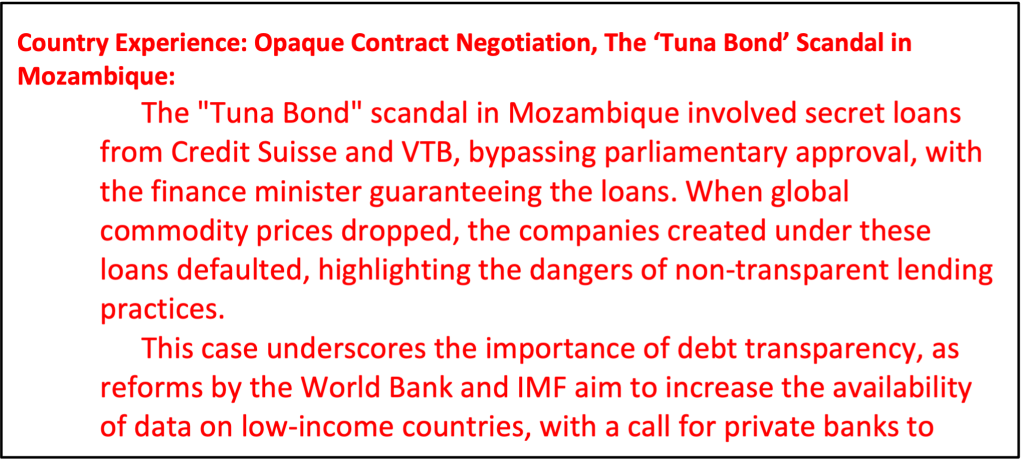
19:33 – 21:42 Here is a clip from the Human Coined Podcast Ep.11 “Debt Justice: The Role of Civil Society.” Introducing Tim Jones of Debt Justice UK, who explains what the mobilization of a campaign driven by civil society organization would look like, specifically noting the Credit Suisse Scandal in Mozambique.
Discussion Questions:
Your answers will be shared with the other e-course participants.
- Does your CSO work on addressing public debt? Is it a priority issue?
- Is your CSO in a debt justice alliance?
- Do you know of any debt justice alliances?
- What do you think are the benefits of joining a debt justice alliance?
- Would your debt justice alliance be national or regional?
Upload your answers in the comment box provided below
2. Debt Audits:
- Debt audits are a crucial tool in assessing the legitimacy and sustainability of a country’s debt. A debt audit involves a comprehensive examination of a government’s debt obligations to determine their origin, structure, and impact on the economy and society. This process helps identify whether debts were contracted in a transparent, legal, and accountable manner, and whether they have contributed to the public good or merely served the interests of a select few.
- Debt audits can reveal cases of illegitimate or odious debt, where funds were misused, leading to calls for debt cancellation or restructuring. By scrutinizing the terms and conditions of loans, the actors involved, and the broader socio-economic implications, debt audits aim to ensure that public debt serves the interests of the population rather than exacerbating economic inequalities or burdening future generations.
Example/Video on Debt Audits:
3:15 – 5:42 Here is a clip from the Human Coined Podcast “Debt Justice: The Role of Civil Society (Part II).” Introducing Mae Buenaventura from the Asian People’s Movement on Debt and Development, who discusses the resistance faced in the campaign for a debt audit in the Philippines.
5:42 – 7:36 Here is a clip from the Human Coined Podcast “Debt Justice: The Role of Civil Society (Part II).” Introducing Mae Buenaventura from the Asian People’s Movement on Debt and Development, who is speaking on the reasons why the President of the Philippines vetoed a bill on implementing a debt audit in 2008 after it was passed by Congress.
12:50 – 14:29 Here is a clip from the Human Coined Podcast “Debt Justice: The Role of Civil Society (Part II).” Please welcome Mae Buenaventura from the Asian People’s Movement on Debt and Development, who will discuss debt audits in the region, focusing on their limited success in Asia.
3. Advocacy for Improved Debt Transparency:
What is Opaque Debt?
- Opaque debt refers to non-transparent lending and borrowing practices.
- Financial activities are not fully disclosed, making it difficult to track the flow of funds.
- Lack of transparency prevents governments and lenders from being held accountable for their financial decisions.
- Opaque debt can take various forms:
- Unreported or incompletely reported debt: 44% of low-income countries have not published any sovereign debt data in the past two years.
- Confidentiality clauses in loan agreements or non-market domestic debt issuance, which obscure the true size of a country’s debt.
- Resource-backed loans: Often negotiated through state-owned enterprises (SOEs) and not classified as official debt.
- The issue of opaque debt is further complicated by:
- Involvement of private creditors, whose lending practices lack sufficient transparency.
- Initiatives like China’s Belt and Road Initiative, which often include confidential terms that prevent public disclosure. (NDI-OGP Policy Brief Series: August 2022)
Countering Opaque Debt: The Value of Transparency
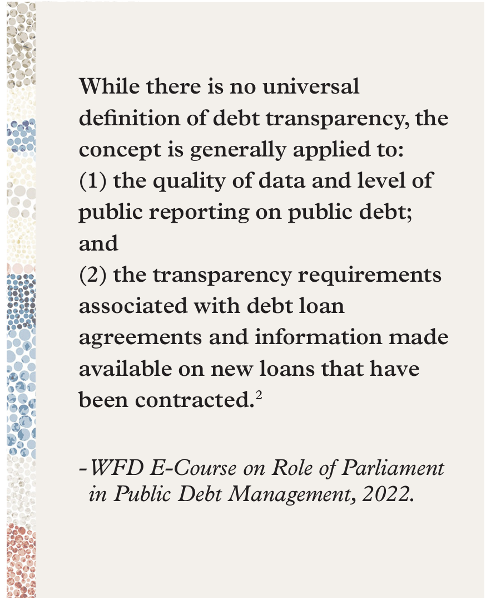
The central solution to addressing opaque debt is enhancing transparency. Transparency, as defined by Transparency International, involves the clear disclosure of information, rules, plans, processes, and actions. In the context of debt, transparency ensures that borrowing decisions are based on complete information, which is critical for maintaining debt stability and macroeconomic health. Debt transparency enables governments to manage risks better, avoid high borrowing costs, and maintain public confidence. It also allows creditors and investors to accurately assess a state’s creditworthiness, reducing the risk premiums associated with uncertainty. A robust debt transparency framework is essential, including transparent debt reporting and clear, legitimate borrowing practices. The adoption of such frameworks has been shown to attract fresh investments by increasing state credibility. Furthermore, transparency is vital for holding governments accountable and ensuring that debt is incurred at the lowest possible cost and within acceptable risk boundaries.
- Transparency in debt management is vital for building trust and ensuring that borrowed funds are used effectively. Parliaments and CSOs can advocate for the disclosure of debt information, including loan agreements, debt servicing schedules, and government guarantees. This information should be accessible to the public to enable informed discussions and decision-making.
The World Bank Debt Transparency Heat Map
As noted in Module 1:
- According to the World Bank, the Public Debt Transparency Heat Map assesses public debt dissemination practices in International Development Association (IDA) countries, including:
- Public debt statistics dissemination practices; and
- Publication of key debt management reports; and
- Publication of other countries’ relevant debt data, including contingent liabilities.
The heat map assesses whether the public debt statistics that are circulated are complete and provided in a timely manner, whether key public debt management documents are publicly available, and whether the government reports on all or just some contingent liabilities. (World Bank, 2023).
-
November 29, 2024 1:34 pm
My organization is not working on debt, but is cognizant of the fact that unsustainable debt affects service delivery to the detriment of the poor. We are supporters of the Debt Justice campaign.
Joining the debt justice alliance will secure that we have allies, skills and information on sustainable debt management
-
November 30, 2024 11:46 pm
No my organization does not address public debt
The benefits of joining debt justice alliance are:
It can strengthen collective voice for fair debt policies by pooling resources, fostering collaboration, and increasing visibility.
Can connect like-minded individuals and organizations, attracting public support and attention. -
December 2, 2024 8:24 pm
Votre OSC travaille-t-elle sur la gestion de la dette publique ?
Oui nous travaillons le réseau pour la réduction section du Niger
de la dette Est-ce un enjeu prioritaire ?
Oui dans la mesure où une dette odieuse peut compromettre l’avenir de nos peuple en leurs ôtant toutes possibilités d’investissement dans les secteurs porteurs, mais plutôt ,comment faire face aux services de la dette arrivée à échéance
Votre OSC est-elle membre d’une alliance pour la justice de la dette ?
Non; mais nous travaillons avec le RNDD
Connaissez-vous des alliances pour la justice de la dette ?
Oui dans les cadre des forum social mondial et africain
Selon vous, quels sont les avantages de rejoindre une alliance pour la justice de la dette ?
La mutualisation des forces , expertises et expériences pour faire face aux Lobis des dettes odieuses
Votre alliance pour la justice de la dette serait-elle nationale ou régionale ?
Régionale pour accroitre l’impact de nos combat d’annulation des dettes odieuses -
December 3, 2024 11:47 pm
Role of Parliament in Public Debt Advocacy and Engagement
1. Legislative Oversight:
• Parliament has the authority to approve or reject government budgets, which includes borrowing plans and debt management strategies.
• Through committees such as the Public Accounts Committee, Parliament monitors government borrowing and debt levels, ensuring they align with sustainable fiscal policies.
• Parliament can propose amendments to the budget, including adjustments to borrowing levels and debt management strategies.
2. Public Accountability:
• Parliament conducts public hearings and inquiries to gather information from government officials, experts, and stakeholders about debt management practices.
• Parliament ensures that information related to public debt is made transparent and accessible to the public, enhancing accountability.
3. Policy Formulation:
• Parliament enacts laws and regulations that provide a framework for prudent debt management and borrowing practices.
• Parliament engages with various stakeholders, including CSOs, to inform policy decisions related to public debt.
Role of Civil Society in Public Debt Advocacy and Engagement
1. Advocacy and Awareness:
• CSOs run advocacy campaigns to raise public awareness about the implications of public debt and the importance of sustainable borrowing.
• Through research and policy analysis, CSOs influence government and parliamentary decisions on debt management.
2. Monitoring and Accountability:
• CSOs conduct independent audits and assessments of public debt to highlight issues of mismanagement or corruption.
• CSOs publish reports and findings on public debt, promoting transparency and holding the government accountable.
3. Capacity Building:
• CSOs provide education and training to the public and policymakers on debt management and its implications for sustainable development.
• CSOs offer technical support to parliamentary committees and government agencies involved in debt management.
Collaboration Between Parliament and Civil Society
1. Joint Initiatives:
• : Organizing joint public consultations to gather input from citizens on debt management policies and strategies.
• Holding workshops and seminars to educate and engage with stakeholders on issues related to public debt.
2. Information Sharing:
• Sharing data and research findings between Parliament and CSOs to inform policy decisions and enhance transparency.
• Collaborating to identify and promote best practices in debt management and public financial accountability.
Impact of Multilateral Institutions on Public Debt
1. Financial Assistance:
• These institutions provide financial assistance and policy advice to countries, influencing their debt management strategies and fiscal policies.
2. Capacity Building and Technical Support:
• : Multilateral institutions offer training and workshops to government officials and policymakers on sustainable debt management.
• They help develop and implement policy frameworks that promote prudent borrowing and effective debt management. -
December 5, 2024 11:29 am
1. Does your CSO work on addressing public debt? Is it a priority issue?
Yes, from time to time, the firm acts as Country Counsel in the process of proactive debt management eg through the issuance of a new bond providing the fiscal space required for economic growth in the medium term.
2. Is your CSO in a debt justice alliance?
No
3. Do you know of any debt justice alliances?
In Kenya, there is Fight Inequality Alliance Kenya, which focuses on addressing the root causes of debt and inequality.
4. What do you think are the benefits of joining a debt justice alliance?
There is security in numbers, and pooling knowledge and resources with a common goal gives better results.5. Would your debt justice alliance be national or regional?
Either would do, provided the interests are aligned. -
December 6, 2024 12:33 pm
Benefits of Joining a Debt Justice Alliance:
Collective Advocacy for Fair Debt Policies:A debt justice alliance often focuses on advocating for systemic reforms in how debts are handled, especially focusing on unjust or exploitative debt practices. As part of a collective group, members can work to push for debt cancellation, better repayment terms, or legislation that addresses predatory lending, enabling a larger, unified voice to be heard.
Sharing Resources and Knowledge:Members of such alliances often collaborate and share valuable insights, research, and resources. This can help organizations or individuals better understand the root causes of debt crises and the most effective ways to advocate for change.
Stronger Negotiating Power:By joining forces with other like-minded individuals or groups, members gain greater leverage when negotiating with creditors, governments, or financial institutions. A collective effort can lead to stronger bargaining positions on debt forgiveness, restructuring, or reduction.
The choice between a national or regional debt justice alliance largely depends on the scope of the issues being addressed and the goals of the alliance.
National Alliance:
Broader Influence: A national alliance could focus on systemic national debt issues, such as government debt crises, predatory lending, or nationwide policies on debt relief.
Centralized Advocacy: This model could be more effective in pushing for national policy changes, legislative reforms, and working with federal agencies or national financial institutions.
Coordination Across Diverse Regions: A national alliance could help coordinate efforts across states or provinces, sharing local strategies while working toward common national goals.
Regional Alliance:Localized Focus: A regional alliance could be more focused on specific debt issues within a particular geographical area, addressing challenges unique to that region. For instance, it could address the specific predatory lending practices or economic challenges faced by communities in a particular area.
Community-Based Solutions: Regional alliances could better tailor their advocacy to the specific needs of local populations, ensuring that debt justice campaigns are sensitive to regional socio-economic contexts.
Stronger Community Engagement: Because the alliance would focus on a smaller geographic area, there may be more opportunities for face-to-face engagement and direct action, building stronger local relationships. -
December 7, 2024 2:37 am
As CISLAC, we do work on addressing public debt, and it is a priority issue for us. We recognize that unsustainable debt levels can have severe consequences for Nigeria’s economic development, poverty reduction, and human rights.
CISLAC is a member of the African Forum and Network on Debt and Development (AFRODAD), a regional debt justice alliance. AFRODAD works to promote debt justice, transparency, and accountability in Africa.
Other notable debt justice alliances include:
1. The European Network on Debt and Development (EURODAD)
2. The Latin American Network on Debt, Development and Rights (LATINDADD)
3. The Asian Peoples’ Movement on Debt and Development (APMDD)The benefits of joining a debt justice alliance include:
1. _Amplified voice_: Collective advocacy and campaigning can amplify the voice of individual organizations and promote greater impact.
2. _Shared knowledge and expertise_: Alliances provide a platform for sharing knowledge, research, and best practices, enhancing the capacity of member organizations.
3. _Coordination and collaboration_: Alliances facilitate coordination and collaboration among member organizations, reducing duplication of efforts and promoting more effective advocacy.
4. _Access to resources and support_: Alliances can provide access to resources, such as funding, training, and technical assistance, supporting the work of member organizations.As CISLAC, our debt justice alliance work is primarily focused at the regional level, through our membership in AFRODAD. However, we also engage in national-level advocacy and campaigning on debt justice issues in Nigeria.
-
December 7, 2024 3:59 pm
1- Votre OSC travaille-t-elle sur la question de la dette publique ? S’agit-il d’une question prioritaire ?
Oui, nous faisons parti d’un Groupe de Référence de la Société Civile pour la transparence de Finances Publiques au Cameroun qui adresse de manière prioritaire la question de la dette publique dans notre pays.
2- Votre OSC fait-elle partie d’une alliance pour la justice de la dette ?
Oui nous faisons parti d’un Groupe de Référence de la Société Civile pour la transparence de Finances Publiques au Cameroun et l’un de nos membre ADIN est partenaire d’African Forum and Network on Debt and Développent (AFRODAD).
3-Connaissez-vous des alliances pour la justice de la dette ?
Oui Tax justice Network, à travers CRADEC au Cameroun qui membre de notre groupe de Référence.
4-Quels sont, selon vous, les avantages d’adhérer à une alliance pour la justice de la dette ?
-Adhérer à une alliance pour la justice de la dette présente plusieurs avantages: d’abord i) Solidarité et soutien collectif, ii) Plus de visibilité accrue/ promouvoir un plus grand impact et global. iii) Plaidoyer renforcé (l’union fait la force) vi) Mobilisation communautaire v) Coordination et collaboration : Les alliances facilitent la coordination et la collaboration entre les organisations membres, réduisant ainsi la duplication des efforts et favorisant un plaidoyer plus efficace. vi) Partage des connaissances et de l’expertise: Les alliances offrent une plateforme de partage des connaissances, de la recherche et des meilleures pratiques, renforçant ainsi les capacités des organisations membres.
vii) Coordination et collaboration: Les alliances facilitent la coordination et la collaboration entre les organisations membres, réduisant ainsi la duplication des efforts et favorisant un plaidoyer plus efficace. viii)Accès aux ressources et au soutien : Les alliances peuvent donner accès à des ressources, telles que le financement, la formation et l’assistance technique, soutenant le travail des organisations membres.5)Votre alliance pour la justice de la dette serait-elle nationale ou régionale ?
-Oui notre alliance est Nationale. -
December 8, 2024 5:50 pm
Does your CSO work on addressing public debt? Is it a priority issue?
Yes
Is your CSO in a debt justice alliance?
YesDo you know of any debt justice alliances?
Eurodad
AFRODADWhat do you think are the benefits of joining a debt justice alliance?
Collaborating with other members amplifies the advocacy voices and influence policymakers more effectively.
Alliances often provide access to expertise and resources as well strategic insights for tackling debt-related issues.
Alliances provide networking opportunities where members connects with like-minded individuals and organizations fostering collaboration and learning.
Solidarity: whether National, regional or global alliances allow members to learn from their experiences and share their own.
Would your debt justice alliance be national or regional?
Both
-
December 9, 2024 3:06 pm
1. Does your CSO work on addressing public debt? Is it a priority issue?
Answer
No2. Is your CSO in a debt justice alliance?
Answer
No3. Do you know of any debt justice alliances?
Answer
No4. What would you think are the benefits of joining debt justice alliance?.
Answer
Easing debt service burden would strengthen fiscal policy to promote socio-economic development and priorities spendingOne critical benefit of joining the alliance is the expanded knowledge members of the alliance will accessed in the area of debt relief.
Members of the alliance can engage in diverse interventions , while at the same time intensify advocacy Campaigns on debt justice.5. Would your debt justice alliance be national or regional
Answer
Both -
December 12, 2024 4:20 pm
No my organization does not address public debt
The benefits of joining debt justice alliance are:
It can strengthen collective voice for fair debt policies by pooling resources, fostering collaboration, and increasing visibility.
Can connect like-minded individuals and organizations, attracting public support and attention. -
December 12, 2024 6:56 pm
Really educative .
-
December 18, 2024 9:09 am
our organisation is not involved in debt. justice
-
January 16, 2025 5:14 pm
Notre organisation ne travaille pas directement sur la gestion de la dette publique.Je pense qu ‘au terme de cette formation,je dois avoir un entretien avec les dirigeants de notre organisation pour inscrire la gestion de la dette publique dans nos activités.
Notre organisation CIVIS Côte d’Ivoire ne fait pas encore partie d’une alliance nationale ou internationale.
Appartenir à une alliance nationale ou internationale permet de suivre la gestion de la dette publique et assurer la transparence et la responsabilité du gouvernements.


Leave a Reply