
SECTION 3.4 – EXERCISE 3: APPEARING BEFORE A SECTORAL COMMITTEE
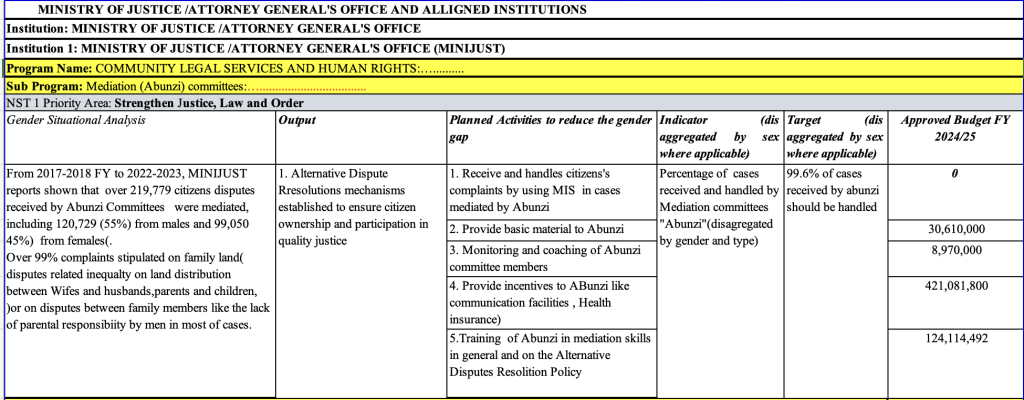
Overview – introduce exercise: You are representing a CSO and have been called to appear before a sectoral parliamentary committee to provide insights on the Gender Budget Statement for a specific sector or ministry. Your task is to analyze and critique the gender-specific initiatives within the ministry’s budget and make recommendations for improvement.
Steps: Using the 2024/25 GBS for Rwanda:
1. Select a Ministry (Sector), preferably one that is in the remit of your CSO. Examples include:
MINEDUC (Education)
MINISANTE (Health)
MINAGRI (Agriculture)
2. Review the Gender Budget Statement for the Selected Ministry or Sector
3. Analyze the gender-specific budget lines for the chosen ministry or sector, focusing on:
- Gender-Related Programs: Identify the programs and initiatives that address gender disparities (e.g., women’s access to healthcare, gender equity in education).
- Budget Allocations: Look at the amount allocated to these gender-related initiatives.
- Objectives: Consider the goals of these initiatives. Are they targeting the most pressing gender-related challenges in the sector?
- Impact: Assess whether the funding is likely to have a significant impact on gender equity in the sector.
4. Prepare Your Presentation for the Sectoral Committee
As a CSO, your goal is to influence the committee’s decision-making on budget allocations. Prepare a 2-3 minute video presentation to address:
- Overview: Briefly explain the key gender-specific initiatives in the ministry’s budget.
- Analysis: Highlight strengths and weaknesses in how gender equity is being addressed.
- Are there sufficient resources allocated to these initiatives?
- Are there areas where gender-focused interventions are missing or underfunded?
- Recommendations: Provide clear, actionable recommendations for the sectoral committee. These might include:
- Increasing funding for under-resourced gender programs.
- Expanding initiatives to reach marginalized or vulnerable groups.
- Strengthening monitoring and evaluation of gender-specific outcomes.
9 Comments
MINEDUC (Education) Programme : Éducation et allocation budgétaire totale/ Sous-programme : Enseignement secondaire. NST 1 Domaine prioritaire auquel le programme répond: Renforcer le dividende démographique en améliorant l’accès à l’éducation de qualité.
Analyse de la situation en matière de genre
Indiquer clairement le problème de genre existant dans le S/P sélectionné, en s’appuyant sur des données ventilées par sexe, le cas échéant.)
La majorité des Camerounais n’ont pas reçu d’éducation formelle ou n’ont suivi qu’une partie de l’enseignement primaire. Plus précisément, 65 % des femmes et 66 % des hommes âgés de 6 ans et plus n’ont pas d’éducation (15 % et 11 % respectivement).
(15% et 11%, respectivement) ou n’ont qu’une partie de l’éducation primaire (50% et 55%, respectivement) (RDHS 2019-2020). Récemment, les résultats de l’enquête RPHC 2022 ont montré que seulement 15,1 % de la population a terminé l’enseignement secondaire, tandis que 53,9 % a suivi un enseignement primaire :
– Longue distance entre le domicile et l’école – Surpopulation dans les salles de classe. Manque d’équipements dans les salles de classe pour les filles dans les écoles Intervention : Construction de salles de classe, de latrines et de cuisines ainsi que l’équipement de salles pour les filles dans différentes écoles.
Résultats
Construction de nouvelles salles de classe, de cuisines et de latrines.
Mise à disposition et équipement de salles pour les filles dans toutes les écoles.
The Ministry of Health’s Gender Budget Statement for 2024/25 demonstrates a commitment to addressing gender disparities in healthcare. However, to enhance the effectiveness of these initiatives, it is crucial to increase funding for under-resourced programs, expand access to marginalized groups, and strengthen monitoring and evaluation mechanisms. By implementing these recommendations, the ministry can significantly improve gender equity in healthcare and ensure better health outcomes for women and girls.
Program: A5 – Environmental Management And Climate Change Resilience:
Gender-Related Programs: Identify the programs and initiatives that address gender disparities (e.g., women’s access to healthcare, gender equity in education).
1. The decoupling hazardous waste Generation from Economic growth project assessment highlights that all activities regarding chemicals and hazardous waste should take into account the gender sensitiveness for instance many women who are involved in plastic waste collection need special protection in order to protect their lives .
• Organize awareness raising and information exchange (4,000 females & 3,500 males) on the sound management of chemicals and hazardous waste.
2. Addressing the significant gap in job creation between men and women in casual jobs (0 to 3 months) and jobs from 3 months and above from projects like Green Gicumbi, TREPA, COMBIO, Resilient & Climate projects among others
• To promote gender balance in job creation (Women: 50% of jobs created) through Promoting innovative partnerships with private sector such as tea factories, East Africa Bamboo factory for value addition, Resilient & Climate projects, non-timber products companies in bee keeping, mushrooms farming.
Objectives: Consider the goals of these initiatives. Are they targeting the most pressing gender-related challenges in the sector?
They are specific in addressing pressing gender related challenges in the sector
MINÉDUC (Éducation)
2. Examiner la déclaration budgétaire sexospécifique pour le ministère ou le secteur sélectionné
Le ministre a dressé un tableau sombre ce la participation des femmes dans certains secteurs de la vie professionnelle du pays de manière suivante:
par exemple, dans les services de transport, les femmes en détiennent 6,4 % contre 93,6 % des hommes, dans l’ingénierie, la fabrication et la construction, les femmes en détiennent 14,4 % contre 85,6 % des hommes, dans la construction et les services de construction, les femmes en détiennent 16,4 % contre 83,6 % des hommes, les femmes 20,6 % contre 79,4 % des hommes dans l’énergie (Annuaire statistique de l’éducation 2019).
Pour enfin proposer des solutions celles de à tripler le nombre de filles scolarisées dans les STEM et l’EFTP afin de faire progresser les opportunités d’emploi des femmes. Actuellement, 43,1 % des filles sont inscrites dans des écoles d’EFTP et 47,7 % des filles sont inscrites dans des écoles secondaires supérieures STEM (2021/22), 21,4 % des filles sont inscrites dans l’ingénierie, la fabrication et la construction dans l’enseignement supérieur (Annuaire statistique de l’éducation, 2021/22).
3. Analyser les lignes budgétaires sexospécifiques pour le ministère ou le secteur choisi, en se concentrant sur :
Programmes liés au genre : identifier les programmes et initiatives qui s’attaquent aux disparités entre les sexes (par exemple, l’accès des femmes aux soins de santé, l’égalité des sexes dans l’éducation).
Formations à la pédagogie sensible au genre (GRP) de 1 000 enseignants du primaire et du secondaire à la GRP Nombre d’enseignants hommes et femmes formés 400 hommes et 600 femmes enseignants du primaire et du secondaire formés à montant de 80 475 436
Création et suivi de clubs pour l’égalité des sexes Formation de 1 000 enseignants du primaire et du secondaire sur le GRP Nombre de clubs pour l’égalité des sexes créés et suivis 10 Clubs pour l’égalité des sexes créés à un montant de 11 931 444
Amélioration la qualité de l’enseignement et de l’apprentissage
Attribution des bourses d’études aux filles et aux femmes
Affectations budgétaires : examinez le montant alloué à ces initiatives liées au genre.
Il décide d’attribuer 29% budget aux action du genre qui ne pas du tout mal
Objectifs : Tenir compte des objectifs de ces initiatives. Ciblent-elles les défis les plus urgents liés au genre dans le secteur ?
Oui à travers les différentes mesures prévues
Impact : Évaluer si le financement est susceptible d’avoir un impact significatif sur l’égalité des sexes dans le secteur.
Oui ,il va permettre aux femmes d’avoir une qualification leurs permettant d’occuper des emplois dans le domaines où elles étaient faiblement représentées tels le transport et les autres secteurs
4. Préparez votre présentation au Comité sectoriel
En tant qu’OSC, votre objectif est d’influencer la prise de décision du comité sur les allocations budgétaires. Préparez une présentation vidéo de 2 à 3 minutes pour aborder les points suivants :
Aperçu : Expliquez brièvement les principales initiatives spécifiques au genre dans le budget du ministère.
Les principales initiatives dans le budget sont: Attribution des bourses pour des femmes en vue d’etudier dans les domaines où elles sont faiblement representées
Renforcements capacités enseignats en pédagogie sensible au genre (GRP) et créations de clubs de genre dans les écoles Écoles primaires et secondaires Enseignants
Analyse : Mettre en évidence les forces et les faiblesses dans la manière dont l’égalité des sexes est abordée
Promotion de l’égalités genre dans l’enseignement(formations) et les emplois.
Les insuffisances , nous sommes pas encore arrivé à la parité entre l’homme et la femme dans la formation et dans les emplois pourquoi pas envisager plus des femme que d’hommes du fait qu’elles plus nombreuses que les homme au regard du pourcentage de la population
Des ressources suffisantes sont-elles allouées à ces initiatives ? A mon avis oui, 29% du budget mais le gouvernement peut mieux faire en tentant d’aller vers la parité femme homme
Existe-t-il des domaines dans lesquels les interventions axées sur le genre sont absentes ou sous-financées ?
Oui la prie en comptes des personnes vivant avec handicap qui sont aussi des groupes vulnérables et marginalisés qui aussi besoins d’être protégées et associées
Recommandations : Formuler des recommandations claires et concrètes à l’intention du comité sectoriel. Celles-ci peuvent inclure :
Augmenter le financement des programmes de genre sous-financés pour arriver à la parité femme homme.
Élargir les initiatives pour atteindre les groupes marginalisés ou vulnérables telles les personnes âgées analphabètes et les personnes vivant avec handicap.
Renforcer le suivi et l’évaluation des résultats spécifiques au genre pour s’assurer les objectifs fixés sont réellement atteints.
In Kenya, the budget approval process offers multiple channels for public engagement, from formal avenues like public hearings and parliamentary debates to informal opportunities such as media discussions, social media platforms, and direct interactions with MPs. Civil society organizations also play a pivotal role in advocating for public participation, ensuring that the budget reflects citizens’ needs. By utilizing these various platforms, individuals and organizations can influence how public funds are allocated and ensure greater transparency and accountability in the budget process
Presentation to Sectoral Committee
Overview: Key Gender-Specific Initiatives in the Ministry’s Budget
1. Women’s Economic Empowerment Programs:
Increase female labor market participation
Support women entrepreneurs through grants and training
2. Gender-Based Violence Prevention and Support:
Funding for shelters and hotlines for survivors
Legal support and advocacy for gender-sensitive laws
3. Health and Reproductive Rights:
Access to comprehensive healthcare services
Programs promoting reproductive health awareness
4. Education and Training:
Scholarships for girls and women in STEM fields
Vocational training programs tailored for women
5. Political Participation and Leadership:
Support initiatives for women candidates
Gender-sensitive electoral reforms
Analysis: Strengths and Weaknesses in Addressing Gender Equity
Strengths:
Holistic Approach: Initiatives address a range of issues from economic empowerment to health and education.
Policy Integration: Gender equity is embedded in broader developmental strategies.
Empowerment Focus: Programs aim for long-term changes in societal norms.
Weaknesses:
Implementation Barriers: Resistance to gender equity in some sectors.
Resource Allocation Gaps: Insufficient funding for comprehensive implementation.
Short-Term Focus Risk: Immediate needs often overshadow long-term strategic goals.
Resource Allocation
Current Allocation: The budget reflects an effort to prioritize gender equity, but gaps exist in actual allocation vs. needs.
Sufficiency: Not fully sufficient to meet the comprehensive needs; reallocation and additional funding are necessary.
Areas with Missing or Underfunded Gender-Focused Interventions
1. Rural Women’s Programs:
Underfunded initiatives targeting rural women’s economic and social empowerment.
2. Intersectional Approaches:
Lack of tailored programs for marginalized groups (e.g., women with disabilities, LGBTQ+ women).
3. Engagement of Men and Boys:
Need for more programs to engage men and boys in promoting gender equity and preventing gender-based violence.
Recommendations for the Sectoral Committee
1. Increase Funding for Rural Women’s Programs:
Ensure adequate resources to support rural women’s unique challenges.
2. Adopt Intersectional Approaches:
Develop and fund programs addressing the diverse needs of marginalized groups.
3. Engage Men and Boys:
Allocate resources to initiatives involving men and boys in gender equity efforts.
4. Enhance Monitoring and Evaluation:
Implement robust mechanisms to track the effectiveness and impact of gender-specific initiatives.
5. Promote Gender-Responsive Budgeting:
Integrate gender-responsive budgeting practices to ensure gender considerations are consistently applied across all sectors.
This presentation aims to provide a comprehensive view of the current state of gender equity initiatives and offers actionable recommendations to improve resource allocation and policy effectiveness
The 2024/25 Gender Budget Statement (GBS) for MINISANTE (Ministry of Health) has several key gender-specific initiatives aimed at addressing disparities in healthcare access. Notably, the budget includes programs targeting maternal health, women’s access to reproductive health services, and efforts to combat gender-based violence. These initiatives are critical for improving gender equity in health, especially for women in rural areas.
However, while these programs are well-intentioned, there are areas for improvement. The allocated budget for maternal health services appears insufficient to meet the growing demand, particularly in underserved regions. Furthermore, while there are provisions for gender-based violence support, they are underfunded, limiting their potential impact. The budget could also benefit from clearer objectives and outcomes, particularly regarding how funds will directly address the most pressing gender challenges, such as rural women’s access to healthcare and sexual reproductive rights.
To improve the effectiveness of these initiatives, I recommend increasing funding for gender-specific programs, especially those that target marginalised groups such as rural women, elderly women, and survivors of gender-based violence. Expanding access to healthcare in these areas will be crucial for achieving the ministry’s gender equity goals. Additionally, strengthening the monitoring and evaluation framework is vital to track the progress of these initiatives and ensure the allocated funds have the desired impact. Lastly, a more comprehensive approach could be adopted to ensure that gender-sensitive healthcare policies are integrated into all aspects of the health sector, not just within isolated programs.
1. Sector
Ministry of Education
1.1 Presentation for the Sectoral Committee – Ministry of Education
1.2 Brief Overview/Background
From the Gender Budget Statement of Ngoma District FY 2024/25, the ministry seeks to address address gender disparity infer the program ‘Access to Quality Education ‘ . The statement clearly state the gender problems in the selected S/P and has also back it with disaggregated data.
2. Review of the Gender Budget Statement
There is great disparity in the ratio of boys compared to girls in accessing education in Ngoma. Therefore concerns have been raised by civil society, child protective partners and international partners about the gap between boys and girls in school given the fact that in Ngoma town children could not access school particularly girls because of distance from their homes to school, overcrowding and lack of materials in equipping rooms for girls in many schools
In view of concerned persons and right based civil society organizations call on the authorities in Ngoma to intervene at once to reverse the growing trends.
3. Analysis of the General Specific Budget Lines For the Ministry of Education
I) initiative used to address gender equity in the education sector
– construction of 15 new classrooms and 24 latrines
– avail and equip girls room at all schools in Ngoma.
+ 100% of schools with girls room equip
Ii) Budget Allocations
Unlike budget allocated for the construction of 15 new school, 24 latrines, the budget for equipping the girls room in all the schools is very small.
III) Objective
From the Gender Budget Statement, I see evidence of addressing concerns for girls by construting 15 new schools, 24 latrines and equipping the rooms for girls in all the schools. This is gender related as it will bridge the divide between school going boys and that of the girls, since 65% of girls and 66% boys age 6 or over have no education.
IV) Impact
All things being equal, the approved budget will no doubt impact on gender equity there changing the narratives.
Recommendations
The following recommendations are hereby advanced for equity to thrive in the education sector.
1. Authorities in the education sector should stand firm that the project on access to quality education on Ngoma town is fully achieved.
2. Budget for subsequent projects should be given top priority and gender consideration with projected figured be at par when factoring gender concerns.
Le ministère de la santé et des affaires sociales et microfinance
La prise en charge gratuite de la césarienne pour les femmes enceintes.
Les forces sont la définition des indicateurs de genre dans le secteur de la santé. Ceci permet d’analyser facilement le budget qui touche les hommes et les femmes.
Comme faiblesse on peut noter la faiblesse de l’exécution des budgets affectés aux problèmes de genre.
Des ressources suffisantes ne sont pas affectées à ces actions.