
SECTION 1.3 – THE BUDGET CYCLE
Overview: This section explores the four stages of the budget cycle and the key actors in the budget process.
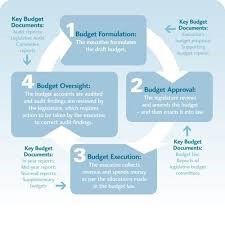
The Budget Cycle
- A country’s PFM system and its budget are tightly linked. The public budget is a government’s plan for how it will raise and spend public funds, reflecting its policy priorities for the budget year. The budget is, however, more than a single document or discrete moment in time (IBP 2008:6). It is a year-long cycle that involves several actors within and outside government and 8 key budget documents.
- The budget cycle is composed of four stages (International Budget Partnership (IBP) 2008:7):
- Budget formulation: when the executive drafts the budget proposal. Budget formulation largely occurs within the executive branch of government and the finance ministry usually coordinates and manages the process. However, as discussed in Module 2, civil society and parliament can play an important role in budget formulation, including identifying key priorities.
- Budget approval: when the legislature discusses, amends, and approves the draft budget. During budget approval, the executive’s budget proposal is presented to the legislature for consideration and approval. As detailed in Module 2, the extent to which parliament revises the draft budget is influenced by a country’s political system, legal framework, and parliamentary capacity to analyze the draft budget.
- Budget execution: when the executive branch collects revenue and spends money according to the allocations in the budget law. As explored in Module 3, the budget is not always implemented as approved. Parliament and civil society both have an important role to play in demanding explanations for budget deviations and holding government to account.
- Budget audit/oversight: when the supreme audit institutions and legislature assess public funds spent for accuracy, compliance, and performance. During the oversight phase, auditors conduct audits verify government financial statements; scrutinize whether government has followed the budget law; and assess whether public resources have been used effectively and efficiently. Parliamentary scrutiny of audit reports is critical to ensuring the executive implements audit recommendations and reports on its progress. Civil society can also help draw attention to audit findings and enhance government responsiveness.
Key budget documents
International standards have identified eight budget documents that should be published at different stages of the budget cycle so civil society and other stakeholders, including parliament, can influence and monitor budget decisions. The table below describes these documents and indicates during which stage of the budget cycle they should be published (IBP 2015:21).
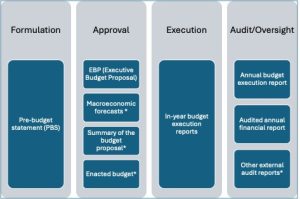
Note: Budget documentation marked with an “*” are optional as per the PEFA Framework, 2016
Key state institutions involved in the budget process:
We will later discover more details in Modules 2, 3, and 4, that three government bodies play a critical role throughout the budget process:
- Executive Branch: Responsible for formulating and executing the budget.
- Parliament: Responsible for approving the draft budget and providing oversight to ensure public funds are used as intended. There are also opportunities to be involved in pre-budget deliberations as well as monitoring implementation of the budget after it is approved by parliament.
- Supreme Audit Institution (SAIs): Conducts audits to ensure government reporting on public finances is accurate and that public funds are managed in compliance with the law and efficiently and effectively.
14 Comments
Well summarized
J’avais fait des commentaires sur les sections précédentes que je ne retrouve pas
Si c’est possible de les retrouver
Je souhaite continuer, mais je n’arrive pas
Je souhaite connaître les heures des séances zoom et lien pour part8
Je viens de lire cette partie
Nous constatons les acteurs majeurs du processus budgétaires sont au nombre de trois à savoir :
Le pouvoir Exécutif incarné par le gouvernement
Le pouvoir législatif représenté par le parlement
Les organes de contrôle représenté par la cour des comptes
Module well presented and in line with prevailing situation in Sierra Leone
Module clearly depicts the current situation in Sierra Leone
Nous constatons ici les acteurs clés, les 4 phases du processus budgétaire et les 8 documents de l’enquête sur le Budget ouvert.
Acteurs qui sont:
L’exécutif avec la Direction générale du budget et de l’Economie
L’assemblée nationale
L’ISC: la Cour des Comptes
Bien résumé 👍
Quality explanations.
well summarised and beneficial
When some one searches for his required thing, thus he/she
desires to be available that in detail, therefore that thing
is maintained over here.