
SECTION 1.5 – GENDER RESPONSIVE BUDGETING
Image: visual representing the integration of gender equality objectives into government policies and budgeting processes
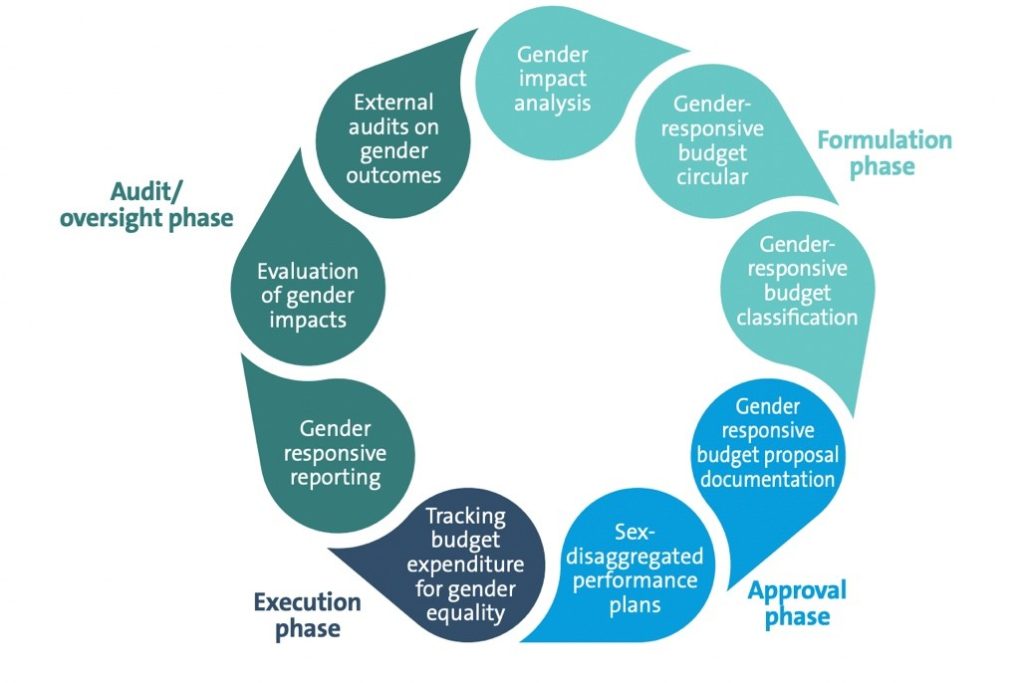
UN Women, 2022. “Action Kit: Engaging Parliaments in Gender Responsive Budgeting” More information can be found on page 19 of the publication regarding gender analysis throughout the budget cycle.
Overview: This section introduces Gender Responsive Budgeting (GRB) and explores its relevance to Parliament, Public Financial Management (PFM), and Civil Society Organizations (CSOs). Participants will learn about the strategic policy approach of GRB and how Parliamentarians can advance gender equality through active engagement in the budget cycle.
Infographic: An infographic showcasing the components of GRB and its impact on policy, planning, and budgeting.
What is Gender-Responsive Budgeting (GRB) and Why is it Relevant?
GRB, evolving since the 1980s, has shifted from a narrow focus on ‘women-specific’ issues to a comprehensive fiscal approach that incorporates gender perspectives across all governmental policy, planning, and budgeting. It aims to advance gender equality and bridge gender disparities by making fiscal policies more attuned to gender impacts, thus enhancing policy decisions.
GRB is integrated into each e-course module. Module 2 focuses on how civil society and parliaments can advocate for GRB during budget planning, formulation, and approval, ensuring gender and intersectionality are considered for equitable outcomes. Module 3 highlights the role of SAIs and civil society in gender-responsive audits, monitoring budget implementation, and ensuring gender promises are fulfilled. Module 4 addresses the disproportionate impact of debt repayment on women and marginalized groups, advocating for a gender-responsive approach to public debt management.
Gender-Responsive Budgeting (GRB) and the Budget Cycle
Here are Key Points to note:
- GRB is a strategic policy approach to integrating gender equality objectives into government processes.
- It ensures that policies, planning, budgeting, monitoring, evaluation, and audits are gender responsive.
- Parliamentarians play a crucial role in advancing gender equality through active engagement in GRB throughout the budget cycle.
Gender-responsive budgeting (GRB) refers to the process of designing and analyzing government budgets to ensure that they equitably benefit individuals of all genders, including women, men, girls, boys, and gender minorities. It aims to address gender disparities by evaluating how revenues are raised and allocated, ensuring that public resources contribute to gender equality and addressing the different needs and roles of all genders in society. GRB is not about creating separate budgets for women, but about incorporating a gender perspective into all aspects of the budget process, from revenue collection to public expenditure, so that the budget promotes equal opportunities and gender justice.
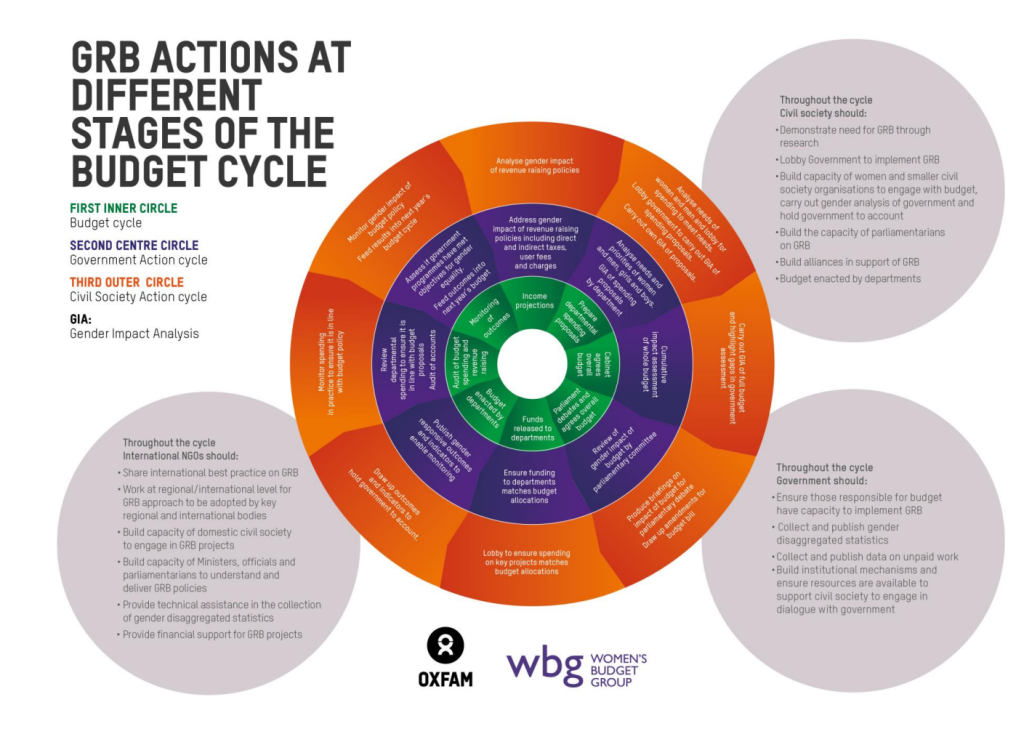
In this module, we will explore the stages of the budget cycle through the lens of gender-responsive budgeting. The diagram used in this training is designed to help stakeholders—government officials, civil society organizations (CSOs), and international partners—identify key actions at each phase of the budget process to promote GRB. The budget cycle itself is represented by three key layers:
1. Inner Circle (Green): This represents the typical stages of the national budget cycle. It includes key phases such as formulation, approval, execution, and audit. Each stage of the cycle represents an opportunity to integrate gender analysis to ensure that the budget responds to the needs of all citizens, including marginalized groups.
2. Middle Circle (Purple): This layer outlines the actions that governments should undertake at each stage to ensure that the budget is gender-responsive. For example, during the budget formulation stage, governments should conduct gender analysis of proposed policies and programs, while during execution, they should ensure gender-equitable access to resources and services.
3. Outer Circle (Orange): This highlights the actions that CSOs can take to promote GRB throughout the budget cycle. These actions include advocacy for GRB at the formulation stage, monitoring budget execution, and evaluating gender impacts during the audit stage. CSOs play a critical role in holding governments accountable and ensuring that gender equity is prioritized.
Additionally, the diagram shows three grey circles representing continuous actions, such as training, capacity building, and international support, which should occur throughout the entire budget process. These actions aim to strengthen the capacity of both governments and CSOs to effectively implement and advocate for GRB.
Video: Watch a video explaining the concept of GRB and its significance to Parliament, PFM, and CSOs. Clip from Human Coined Episode “Not Your Ordinary Gender Budgeting Conversation”
Questions for Consideration:
Upload your answers in the comment box provided below
Your answers will be shared with only the course facilitator.
- How can GRB contribute to more equitable resource allocation in government budgets?
- What challenges do you foresee in implementing GRB in your country?
-
Oui La budgétisation sensible au genre peut contribuer à une répartition plus équitable des ressources dans les budgets publics:
Dans le Cas du Cameroun La BSG est opérationnelle depuis quelques années avec comme faits marquants :
– la prise en compte du genre est instruite chaque année par le Président de la République dans le cadre de la préparation du budget ;
– la répercussion des instructions présidentielles par le ministre de finances indiquant aux administrations comment prendre en compte le genre dans le budget ;
– l’élaboration d’un Document Budgétaire Sensible au Genre, annexé à la loi de finances depuis 2021.
En 2024, un montant de 74,74 milliards de FCFA avait été prévu par les ministères pilotes pour réduire les inégalités entre les hommes et les femmes (les garçons et les filles)
Quels défis prévoyez-vous dans la mise en œuvre de la BSG au Cameroun pourrait rencontrer plusieurs défis:
i) Manque de sensibilisation et de formation: l’absence de compréhension des principes et des avantages de la BSG peut limiter son adoption, ii) Résistance au changement: Les organisation peuvent être réticentes à modifier leurs méthodes de gestion traditionnelles; iii) Infrastructures insuffisantes, iv) engagement des parties parties prenantes, La BSG nécessite l’engagement de tous les niveaux de l’organisation. v) Ressources financières et humaines. Il est crucial d’adopter une approche proactive, impliquant formation, communication, et engagement des parties prenantes dès le début du processus -
By addressing gender disparities through evaluating how revenues are raised and allocated, ensuring that public resources contribute to gender equality and addressing the different needs and roles of all genders in society.
Inadeguate gender analysis of proposed policies and programs
Limited capacity of both government and CSOs to effectively implement and advocate for GRB. -
Advice on gender-related proposals at formulation stage
Organizing debates and hearings focused on how budget proposals impact gender outcomes at approval stage
Review gender impacts in in-year and mid-year reports on government programs at execution stage
Provide valuable insights and detailed reports to help parliament in scrutinizing gender-related outcomes at audit stageMore capacity building on GRB to CSOs
Financial support to CSOs to enable them engage with communities -
How can GRB contribute to more equitable resource allocation in government budgets?
Answer: Prompt response in addressing budget allocation towards GRB. In the midst of growing economic difficulties public resources should be skewed in line with gender roles without any pre-conditionality
What challenges do you foresee in implementing GRB in your country?
Answer: Inadequate gender analysis of proposed policies and programs
Limited capacity of both government and CSOs to effectively implement and advocate for GRB. -
How can your CSO support Parliamentarians in implementing GRB using the Action Kit?
Answer:
Periodic participation in the formulation of proposals at the initial/formulation stage
Hold community and town hall meetings focusing on GRB at approval stage
Review gender impacts in at the execution stage
Provide valuable statistics and detailed analysis on gender related activities that will provide the basis for parliamentary scrutiny on outcomes at audit stageMore capacity building on GRB to CSOs
Financial support to CSOs to enable them engage with communitiesAnswer:
What additional support or resources may be needed to effectively engage parliaments in promoting gender equality through budgeting?
-
Gender Responsive Budgeting (GRB) promotes equitable resource allocation by addressing gender-specific needs in areas like health and education. In Kenya, challenges to its implementation include limited political will, insufficient gender-disaggregated data, and resistance to changing traditional budgeting practices.
-
CSO can support Parliamentarians in implementing GRB using the Action Kit by organizing debates and hearings on how budget proposals impact gender outcomes at different stages of the budget cycle.
The additional support or resources that may be needed to effectively engage parliaments in promoting gender equality through budgeting include mobilisation of CSOs and other actors to generate views on the budget proposals
-
Les OSC peuvent aider les parlementaires à mettre en œuvre la BSG a travers un certains nombre d’actions au rang desquelles: des formations sur le concept de de la BSG pour appropriation par les parlementaires, à travers l’accompagnement des parlementaires vers l’élaboration des projets de lois mettant en évidence le concept de genre pour la protection des citoyens marginalisés, en soutenant le voie des OSCs au niveau du gouvernement pour relayer les questions sur la BSG . EN collaborant avec les OSC lors des débats d’orientation budgétaire pour adresser les questions sur le BSG dans le cadre des questions ouvertes au gouvernement. Enfin mettre en place une réseaux des parlementaires pour soutenir les actions allant vers la à suppression des lois discriminatoires en vigueur dans les pays contre la BSG;
-
1. How can GRB contribute to more equitable resource allocation in government budgets?
Gender Responsive Budgeting (GRB) ensured gender specific needs, challenges, and contributions are considered in the budgeting process. This is considering GRB focuses on addressing gender inequalities in access to resources, services, and opportunities, the ultimate beneficiary of this process is the society as a whole.
2. What challenges do you foresee in implementing GRB in your country?
In Kenya, the key challenges in implementing GRB include: Lack of political will; Weak institutional framework; Lack of technical capacity and skills; and Potential difficulty in taking stock of progress and see potential areas of change.
-
1. How can your CSO support Parliamentarians in implementing GRB using the Action Kit?
Using the Action Kit as a useful manual, we can support Parliamentarians with the necessary legal analysis, Advising on the GRB amendments, capacity building, and legal and technical advice throughout the process.2. What additional support or resources may be needed to effectively engage parliaments in promoting gender equality through budgeting?
Enhanced media engagement; Enhancing accountability mechanisms; Alignment of the legislative frameworks are necessary for the successful implementation of GRB in order to establish a strong, long-lasting strategy for GRB in Kenya. -
dans mesure où elle permet de prendre en compte les préoccupations réelles des groupes vulnérables et marginalisés dans le budget de l’Etat de ses démembrements
Les défis de la participations des concernés à la définition des politiques et les discussion budgétaires et la prise en compte de leurs préoccupations exprimées lors des discutions et les consultations populaires -
Comment votre OSC peut-elle aider les parlementaires à mettre en œuvre la BSG à l’aide du kit d’action ?
En produisant des évidences à travers des études portants sur la prise en compte du genre dans les politique publique et les analyses des rapports gouvernementaux d’exécution budgétaires
De quel soutien ou de quelles ressources supplémentaires pourraient être nécessaires pour impliquer efficacement les parlements dans la promotion de l’égalité des sexes par le biais de la budgétisation ?
un renforcement des capacités des parlementaires en matière de la BSG genre et de l’élimination et ou la réduction des inégalités sociales
leur organiser des voyage d’études dans des pays où la BSG à donner des fruits(reussite) -
In Zambia, progressive budgeting is on paper one of the key priorities. It is reflected in the National Development Plans. Gender Responsive Budgeting (GRB) promotes equitable resource allocation by ensuring public spending addresses the specific needs of all genders, particularly women, girls and marginalized groups. It helps target disparities in access to critical services such as healthcare, education, and social protection, improving outcomes for underserved populations. Fiscal justice through GRB fosters transparency by linking funding decisions to measurable gender equity outcomes, such as reducing gender-based violence or enhancing girls’ education. This approach also drives economic growth, as empowering women through targeted investments boosts workforce participation, entrepreneurship, and poverty reduction.
However, implementing GRB in Zambia faces several hurdles. It is limited by the lack of quality gender-disaggregated data which constrains evidence-based planning, while insufficient institutional capacity hampers the integration of gender analysis into budgeting. Cultural norms and resistance to gender equity initiatives can undermine political will, and Zambia’s constrained fiscal space limits funding for gender-focused programs. Weak inter-agency coordination and inconsistent political commitment further complicate efforts to institutionalize GRB. Zambia is signatory to various international agreements and has been prioitising gender mainstreaming all pointing towards progressive policy and legislation but the enforcement and application of all the above.
-
according to recent surveys, the global value of unpaid care and domestic work for women aged 15 and over stands at around $10.8 trillion annually – three times the size of the world’s tech industry.
But when gender gaps are brought to the surface, governments can target available resources to address gender inequalities and support sustainable, inclusive development for all.
Gender-responsive budgets foster a sense of justice, strengthen government accountability, and support better alignment of national budgets with Sustainable Development Goals (SDGs). -
La BSG permet de réduire les inégalités. Le défi majeur dans mon pays c’est l’exécution des budgets avec la sensibilité genre car la note d’analyse budgétaire sensible genre présente les prévisions mais c’est au niveau de l’exécution pour une réduction réelle des inégalités qu’il faut se pencher
-
La meilleure d’aider les parlementaires est de présenter le diagnostic des inégalités genre dans les ministères sectoriels et convaincre ces derniers des gains pour le pays s’ils d’engagent à œuvrer pour réduire ces inégalités. Exposer aussi les bénéfices du BSG sur les citoyens
-
Gender Responsive Budgeting (GRB) is a crucial approach to promoting gender equality and equitable resource allocation in government budgets. Here are some ways GRB can contribute to more equitable resource allocation:
Analyzing Budgets through a Gender Lens
1. Identifying gender biases: GRB helps identify gender biases in budget allocations, ensuring that resources are distributed fairly and address the needs of all citizens.
2. Assessing gender impacts: GRB assesses the gendered impacts of budget policies and programs, enabling governments to make informed decisions.Promoting Gender Equality
1. Addressing gender disparities: GRB addresses gender disparities in areas like education, healthcare, and economic empowerment.
2. Supporting gender-sensitive programs: GRB supports programs that promote gender equality, such as initiatives to combat gender-based violence.Improving Resource Allocation
1. Allocating resources effectively: GRB ensures that resources are allocated effectively to address the needs of all citizens, regardless of gender.
2. Reducing gender-based inequalities: GRB reduces gender-based inequalities by allocating resources to programs that promote gender equality.Enhancing Transparency and Accountability
1. Promoting budget transparency: GRB promotes budget transparency, enabling citizens to track how resources are being allocated.
2. Holding governments accountable: GRB holds governments accountable for their budget decisions, ensuring that they prioritize gender equality.Fostering Stakeholder Engagement
1. Encouraging citizen participation: GRB encourages citizen participation in budget processes, ensuring that diverse voices are heard.
2. Collaborating with civil society: GRB collaborates with civil society organizations to promote gender equality and equitable resource allocation. -
CISLAC (Civil Society Legislative Advocacy Centre) can support Parliamentarians in implementing Gender Responsive Budgeting (GRB) using the Action Kit in several ways:
Support for Parliamentarians
1. Capacity Building: Provide training and capacity-building programs for Parliamentarians on GRB, focusing on the Action Kit and its implementation.
2. Technical Assistance: Offer technical assistance to Parliamentarians in analyzing budgets, identifying gender biases, and developing gender-responsive budget policies.
3. Policy Briefs and Research: Develop policy briefs and research papers on GRB, providing Parliamentarians with evidence-based information to inform their decisions.
4. Advocacy and Lobbying: Support Parliamentarians in advocating for GRB policies and reforms, helping to build a coalition of supporters within the parliament.Additional Support and Resources
1. GRB Experts: Collaborate with GRB experts and consultants to provide specialized technical assistance to Parliamentarians.
2. International Best Practices: Facilitate study tours and exposure visits for Parliamentarians to learn from international best practices in GRB.
3. Citizen Engagement: Support Parliamentarians in engaging with citizens, particularly women and marginalized groups, to ensure that their needs and priorities are reflected in the budget.
4. Budget Analysis Tools: Develop and provide user-friendly budget analysis tools and software to help Parliamentarians analyze budgets and track GRB implementation.
5. Sensitization and Awareness Creation: Organize sensitization and awareness programs for Parliamentarians, parliamentary staff, and other stakeholders on the importance of GRB and its implementation.
6. *Monitoring and Evaluation*: Establish a monitoring and evaluation framework to track the implementation of GRB policies and reforms, providing feedback to Parliamentarians and other stakeholders.By providing these forms of support and resources, CISLAC can effectively engage parliaments in promoting gender equality through budgeting.
-
How can your CSO support Parliamentarians in implementing GRB using the Action Kit?
– CSOs can monitor the implementation of GRB and hold the government accountable for its commitments to gender equality. They can also provide feedback and recommendations for improvement
– CSOs can also organize training sessions and workshops to enhance the understanding and skills of parliamentarians and their staff on GRB principles and practices.What additional support or resources may be needed to effectively engage parliaments in promoting gender equality through budgeting?
– Strengthening legal and policy frameworks to support gender equality and GRB. This includes enacting laws that mandate gender analysis in budgeting processes -
1. Comment la budgétisation sensible au genre peut-elle contribuer à une répartition plus équitable des ressources dans les budgets publics ?
A travers la réduction des inégalités en tenant compte de toutes les préoccupations des couches vulnérables dans le domaine de la santé, éducation et protection sociale
2. Quels défis prévoyez vous dans la mise en œuvre de la BSG dans votre pays ?
La prise en compte des préoccupations exprimé lors des discussions, la réduction des violences sexistes et l’autonomisation des femmes -
By analyzing the impact of fiscal policies on women, men, and other groups, GRB promotes fair resource distribution to sectors like healthcare, education, and social services. This approach helps reduce gender disparities, advance social equity, and empower vulnerable populations by aligning government spending with equality objectives. In Mauritius, challenges to implementing GRB include limited awareness and capacity among policymakers, insufficient gender-disaggregated data, and resistance to integrating GRB into traditional budget processes. Resource constraints for training and monitoring, as well as aligning GRB with national development priorities, pose additional hurdles. Addressing these challenges requires strong political will, capacity-building initiatives, and cross-sectoral collaboration to ensure successful implementation.
-
The Action Kit can guide parliamentarians in identifying gender gaps, setting gender-equity priorities, and monitoring budget implementation to ensure it meets the needs of all citizens. Additionally, the CSO can facilitate dialogue between parliamentarians, civil society, and communities to ensure inclusive input into the budget process. To effectively engage parliaments, additional support may include capacity-building programs for parliamentarians, gender-disaggregated data to inform decision-making, and technical assistance for integrating GRB into budgetary frameworks. Resources like advocacy toolkits, case studies, and partnerships with gender equality experts can further enhance engagement. Institutional support, such as dedicated GRB committees or units within parliament, can also ensure sustained efforts toward promoting gender equality through budgeting.
-
GRB makes for effective mainstreaming of gender issues into the budget and PFM process. This will guide policy makers and Government in planning across various sectors (education, health etc).


Parliament’s Role in Advancing Gender Equality
Infographic / Video:
Explore how Parliamentarians can actively engage in GRB to advance gender equality.
Key Points:
- Parliamentarians are well-placed to advocate for gender-responsive policies and budgets.
- Their active engagement in GRB can lead to more inclusive and equitable outcomes.
- Parliamentary oversight ensures that gender equality objectives are integrated into budget allocations and expenditures.
The roles of parliamentarians in GRB are covered in more detail in Modules 2, 3 and 4.
The PEFA Gender Responsive PFM Framework
Infographic:
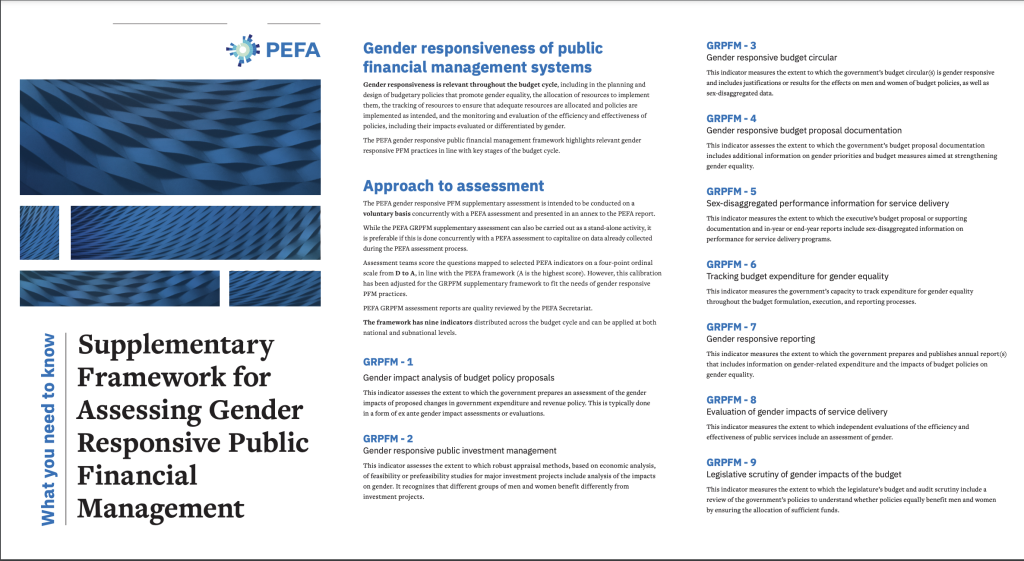
Introduction to the PEFA Gender Responsive PFM Framework and its application in promoting gender equality in budgeting.
Key Points:
- The PEFA Gender Responsive PFM Framework provides a systematic approach to integrating gender considerations into PFM processes.
- It assists governments in assessing and improving the gender responsiveness of their budgeting systems.
- Parliamentarians can use this framework to promote gender equality throughout the budget cycle by ensuring that the PFM system takes into account the different needs of women, men, and other gender groups. By working with this framework, they can push for budgets that prioritize equal opportunities for everyone and ensure that resources are distributed fairly at each stage of the budget process.
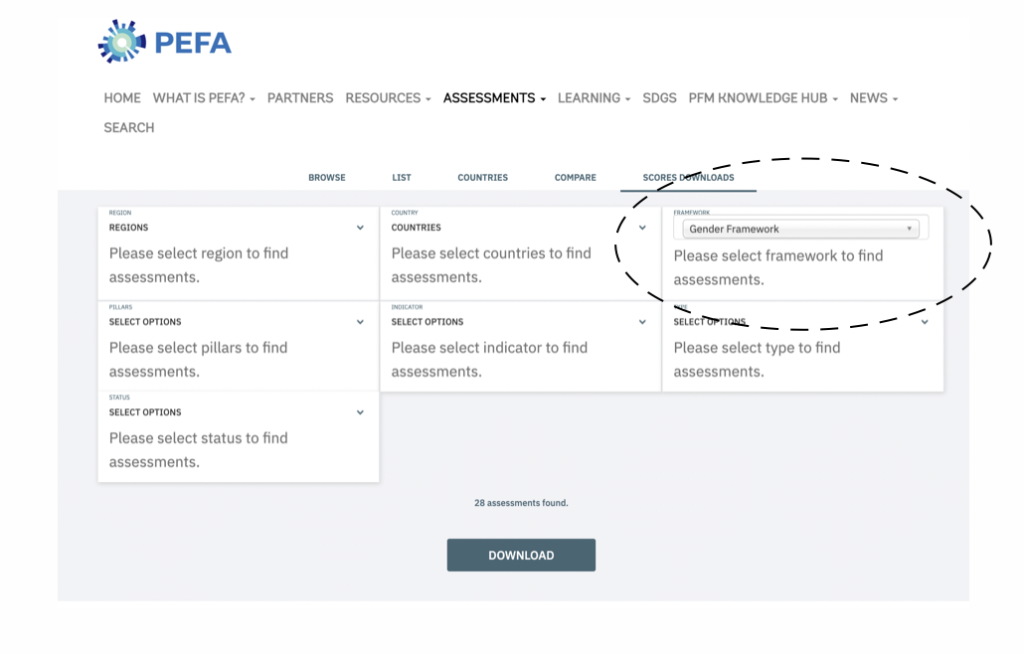
- Has a GRPFM been conducted in your country? Click on the infographic below and select “gender framework”.
https://www.pefa.org/assessments/batch-downloads
Action Kit on Engaging Parliaments in GRB
Infographic: Learn about the Action Kit designed to guide parliaments in effectively engaging with GRB.
Key Points:
- The Action Kit provides practical tools and resources for parliamentarians to integrate gender considerations into their legislative processes.
- It includes guidelines, case studies, and best practices for promoting gender equality through budgetary decisions.
- CSOs can also use this kit to collaborate with parliamentarians in advancing gender-responsive policies and budgets:
- How Parliamentarians Can Support Gender Equality Throughout the Budget Cycle (With the Support of CSOs): *
- Formulation Phase: Parliamentarians can push for gender-responsive budgeting by encouraging the Minister of Finance to consider gender impact assessments when planning budgets. Parliamentary committees can invite experts and CSOs to provide advice on gender-related proposals during this stage.
- Approval Phase: During budget approval, parliamentarians can check if the government’s gender equality goals are aligned with the funding in the budget. Parliamentary committees, alongside CSOs, can promote gender equality by organizing debates and hearings focused on how budget proposals impact gender outcomes.
- Execution Phase: Parliamentarians can request information on the gender impact of any changes to spending and assess how reallocations affect gender equality. Parliamentary committees, with input from CSOs, can review gender impacts in in-year and mid-year reports on government programs.
- Audit and Oversight Phase: Parliament can review gender audits and analyses from the government and Supreme Audit Institutions (SAIs) to ensure the government’s gender equality commitments are met. CSOs can provide valuable insights and detailed reports to help parliament in scrutinizing gender-related outcomes.
- *Adapted from the Action Kit, p. 47.
Questions for Consideration:
Upload your answers in the comment box provided below
Your answers will be shared with only the course facilitator.
- How can your CSO support Parliamentarians in implementing GRB using the Action Kit?
- What additional support or resources may be needed to effectively engage parliaments in promoting gender equality through budgeting?
-
Oui La budgétisation sensible au genre peut contribuer à une répartition plus équitable des ressources dans les budgets publics:
Dans le Cas du Cameroun La BSG est opérationnelle depuis quelques années avec comme faits marquants :
– la prise en compte du genre est instruite chaque année par le Président de la République dans le cadre de la préparation du budget ;
– la répercussion des instructions présidentielles par le ministre de finances indiquant aux administrations comment prendre en compte le genre dans le budget ;
– l’élaboration d’un Document Budgétaire Sensible au Genre, annexé à la loi de finances depuis 2021.
En 2024, un montant de 74,74 milliards de FCFA avait été prévu par les ministères pilotes pour réduire les inégalités entre les hommes et les femmes (les garçons et les filles)
Quels défis prévoyez-vous dans la mise en œuvre de la BSG au Cameroun pourrait rencontrer plusieurs défis:
i) Manque de sensibilisation et de formation: l’absence de compréhension des principes et des avantages de la BSG peut limiter son adoption, ii) Résistance au changement: Les organisation peuvent être réticentes à modifier leurs méthodes de gestion traditionnelles; iii) Infrastructures insuffisantes, iv) engagement des parties parties prenantes, La BSG nécessite l’engagement de tous les niveaux de l’organisation. v) Ressources financières et humaines. Il est crucial d’adopter une approche proactive, impliquant formation, communication, et engagement des parties prenantes dès le début du processus -
By addressing gender disparities through evaluating how revenues are raised and allocated, ensuring that public resources contribute to gender equality and addressing the different needs and roles of all genders in society.
Inadeguate gender analysis of proposed policies and programs
Limited capacity of both government and CSOs to effectively implement and advocate for GRB. -
Advice on gender-related proposals at formulation stage
Organizing debates and hearings focused on how budget proposals impact gender outcomes at approval stage
Review gender impacts in in-year and mid-year reports on government programs at execution stage
Provide valuable insights and detailed reports to help parliament in scrutinizing gender-related outcomes at audit stageMore capacity building on GRB to CSOs
Financial support to CSOs to enable them engage with communities -
How can GRB contribute to more equitable resource allocation in government budgets?
Answer: Prompt response in addressing budget allocation towards GRB. In the midst of growing economic difficulties public resources should be skewed in line with gender roles without any pre-conditionality
What challenges do you foresee in implementing GRB in your country?
Answer: Inadequate gender analysis of proposed policies and programs
Limited capacity of both government and CSOs to effectively implement and advocate for GRB. -
How can your CSO support Parliamentarians in implementing GRB using the Action Kit?
Answer:
Periodic participation in the formulation of proposals at the initial/formulation stage
Hold community and town hall meetings focusing on GRB at approval stage
Review gender impacts in at the execution stage
Provide valuable statistics and detailed analysis on gender related activities that will provide the basis for parliamentary scrutiny on outcomes at audit stageMore capacity building on GRB to CSOs
Financial support to CSOs to enable them engage with communitiesAnswer:
What additional support or resources may be needed to effectively engage parliaments in promoting gender equality through budgeting?
-
Gender Responsive Budgeting (GRB) promotes equitable resource allocation by addressing gender-specific needs in areas like health and education. In Kenya, challenges to its implementation include limited political will, insufficient gender-disaggregated data, and resistance to changing traditional budgeting practices.
-
CSO can support Parliamentarians in implementing GRB using the Action Kit by organizing debates and hearings on how budget proposals impact gender outcomes at different stages of the budget cycle.
The additional support or resources that may be needed to effectively engage parliaments in promoting gender equality through budgeting include mobilisation of CSOs and other actors to generate views on the budget proposals
-
Les OSC peuvent aider les parlementaires à mettre en œuvre la BSG a travers un certains nombre d’actions au rang desquelles: des formations sur le concept de de la BSG pour appropriation par les parlementaires, à travers l’accompagnement des parlementaires vers l’élaboration des projets de lois mettant en évidence le concept de genre pour la protection des citoyens marginalisés, en soutenant le voie des OSCs au niveau du gouvernement pour relayer les questions sur la BSG . EN collaborant avec les OSC lors des débats d’orientation budgétaire pour adresser les questions sur le BSG dans le cadre des questions ouvertes au gouvernement. Enfin mettre en place une réseaux des parlementaires pour soutenir les actions allant vers la à suppression des lois discriminatoires en vigueur dans les pays contre la BSG;
-
1. How can GRB contribute to more equitable resource allocation in government budgets?
Gender Responsive Budgeting (GRB) ensured gender specific needs, challenges, and contributions are considered in the budgeting process. This is considering GRB focuses on addressing gender inequalities in access to resources, services, and opportunities, the ultimate beneficiary of this process is the society as a whole.
2. What challenges do you foresee in implementing GRB in your country?
In Kenya, the key challenges in implementing GRB include: Lack of political will; Weak institutional framework; Lack of technical capacity and skills; and Potential difficulty in taking stock of progress and see potential areas of change.
-
1. How can your CSO support Parliamentarians in implementing GRB using the Action Kit?
Using the Action Kit as a useful manual, we can support Parliamentarians with the necessary legal analysis, Advising on the GRB amendments, capacity building, and legal and technical advice throughout the process.2. What additional support or resources may be needed to effectively engage parliaments in promoting gender equality through budgeting?
Enhanced media engagement; Enhancing accountability mechanisms; Alignment of the legislative frameworks are necessary for the successful implementation of GRB in order to establish a strong, long-lasting strategy for GRB in Kenya. -
dans mesure où elle permet de prendre en compte les préoccupations réelles des groupes vulnérables et marginalisés dans le budget de l’Etat de ses démembrements
Les défis de la participations des concernés à la définition des politiques et les discussion budgétaires et la prise en compte de leurs préoccupations exprimées lors des discutions et les consultations populaires -
Comment votre OSC peut-elle aider les parlementaires à mettre en œuvre la BSG à l’aide du kit d’action ?
En produisant des évidences à travers des études portants sur la prise en compte du genre dans les politique publique et les analyses des rapports gouvernementaux d’exécution budgétaires
De quel soutien ou de quelles ressources supplémentaires pourraient être nécessaires pour impliquer efficacement les parlements dans la promotion de l’égalité des sexes par le biais de la budgétisation ?
un renforcement des capacités des parlementaires en matière de la BSG genre et de l’élimination et ou la réduction des inégalités sociales
leur organiser des voyage d’études dans des pays où la BSG à donner des fruits(reussite) -
In Zambia, progressive budgeting is on paper one of the key priorities. It is reflected in the National Development Plans. Gender Responsive Budgeting (GRB) promotes equitable resource allocation by ensuring public spending addresses the specific needs of all genders, particularly women, girls and marginalized groups. It helps target disparities in access to critical services such as healthcare, education, and social protection, improving outcomes for underserved populations. Fiscal justice through GRB fosters transparency by linking funding decisions to measurable gender equity outcomes, such as reducing gender-based violence or enhancing girls’ education. This approach also drives economic growth, as empowering women through targeted investments boosts workforce participation, entrepreneurship, and poverty reduction.
However, implementing GRB in Zambia faces several hurdles. It is limited by the lack of quality gender-disaggregated data which constrains evidence-based planning, while insufficient institutional capacity hampers the integration of gender analysis into budgeting. Cultural norms and resistance to gender equity initiatives can undermine political will, and Zambia’s constrained fiscal space limits funding for gender-focused programs. Weak inter-agency coordination and inconsistent political commitment further complicate efforts to institutionalize GRB. Zambia is signatory to various international agreements and has been prioitising gender mainstreaming all pointing towards progressive policy and legislation but the enforcement and application of all the above.
-
according to recent surveys, the global value of unpaid care and domestic work for women aged 15 and over stands at around $10.8 trillion annually – three times the size of the world’s tech industry.
But when gender gaps are brought to the surface, governments can target available resources to address gender inequalities and support sustainable, inclusive development for all.
Gender-responsive budgets foster a sense of justice, strengthen government accountability, and support better alignment of national budgets with Sustainable Development Goals (SDGs). -
La BSG permet de réduire les inégalités. Le défi majeur dans mon pays c’est l’exécution des budgets avec la sensibilité genre car la note d’analyse budgétaire sensible genre présente les prévisions mais c’est au niveau de l’exécution pour une réduction réelle des inégalités qu’il faut se pencher
-
La meilleure d’aider les parlementaires est de présenter le diagnostic des inégalités genre dans les ministères sectoriels et convaincre ces derniers des gains pour le pays s’ils d’engagent à œuvrer pour réduire ces inégalités. Exposer aussi les bénéfices du BSG sur les citoyens
-
Gender Responsive Budgeting (GRB) is a crucial approach to promoting gender equality and equitable resource allocation in government budgets. Here are some ways GRB can contribute to more equitable resource allocation:
Analyzing Budgets through a Gender Lens
1. Identifying gender biases: GRB helps identify gender biases in budget allocations, ensuring that resources are distributed fairly and address the needs of all citizens.
2. Assessing gender impacts: GRB assesses the gendered impacts of budget policies and programs, enabling governments to make informed decisions.Promoting Gender Equality
1. Addressing gender disparities: GRB addresses gender disparities in areas like education, healthcare, and economic empowerment.
2. Supporting gender-sensitive programs: GRB supports programs that promote gender equality, such as initiatives to combat gender-based violence.Improving Resource Allocation
1. Allocating resources effectively: GRB ensures that resources are allocated effectively to address the needs of all citizens, regardless of gender.
2. Reducing gender-based inequalities: GRB reduces gender-based inequalities by allocating resources to programs that promote gender equality.Enhancing Transparency and Accountability
1. Promoting budget transparency: GRB promotes budget transparency, enabling citizens to track how resources are being allocated.
2. Holding governments accountable: GRB holds governments accountable for their budget decisions, ensuring that they prioritize gender equality.Fostering Stakeholder Engagement
1. Encouraging citizen participation: GRB encourages citizen participation in budget processes, ensuring that diverse voices are heard.
2. Collaborating with civil society: GRB collaborates with civil society organizations to promote gender equality and equitable resource allocation. -
CISLAC (Civil Society Legislative Advocacy Centre) can support Parliamentarians in implementing Gender Responsive Budgeting (GRB) using the Action Kit in several ways:
Support for Parliamentarians
1. Capacity Building: Provide training and capacity-building programs for Parliamentarians on GRB, focusing on the Action Kit and its implementation.
2. Technical Assistance: Offer technical assistance to Parliamentarians in analyzing budgets, identifying gender biases, and developing gender-responsive budget policies.
3. Policy Briefs and Research: Develop policy briefs and research papers on GRB, providing Parliamentarians with evidence-based information to inform their decisions.
4. Advocacy and Lobbying: Support Parliamentarians in advocating for GRB policies and reforms, helping to build a coalition of supporters within the parliament.Additional Support and Resources
1. GRB Experts: Collaborate with GRB experts and consultants to provide specialized technical assistance to Parliamentarians.
2. International Best Practices: Facilitate study tours and exposure visits for Parliamentarians to learn from international best practices in GRB.
3. Citizen Engagement: Support Parliamentarians in engaging with citizens, particularly women and marginalized groups, to ensure that their needs and priorities are reflected in the budget.
4. Budget Analysis Tools: Develop and provide user-friendly budget analysis tools and software to help Parliamentarians analyze budgets and track GRB implementation.
5. Sensitization and Awareness Creation: Organize sensitization and awareness programs for Parliamentarians, parliamentary staff, and other stakeholders on the importance of GRB and its implementation.
6. *Monitoring and Evaluation*: Establish a monitoring and evaluation framework to track the implementation of GRB policies and reforms, providing feedback to Parliamentarians and other stakeholders.By providing these forms of support and resources, CISLAC can effectively engage parliaments in promoting gender equality through budgeting.
-
How can your CSO support Parliamentarians in implementing GRB using the Action Kit?
– CSOs can monitor the implementation of GRB and hold the government accountable for its commitments to gender equality. They can also provide feedback and recommendations for improvement
– CSOs can also organize training sessions and workshops to enhance the understanding and skills of parliamentarians and their staff on GRB principles and practices.What additional support or resources may be needed to effectively engage parliaments in promoting gender equality through budgeting?
– Strengthening legal and policy frameworks to support gender equality and GRB. This includes enacting laws that mandate gender analysis in budgeting processes -
1. Comment la budgétisation sensible au genre peut-elle contribuer à une répartition plus équitable des ressources dans les budgets publics ?
A travers la réduction des inégalités en tenant compte de toutes les préoccupations des couches vulnérables dans le domaine de la santé, éducation et protection sociale
2. Quels défis prévoyez vous dans la mise en œuvre de la BSG dans votre pays ?
La prise en compte des préoccupations exprimé lors des discussions, la réduction des violences sexistes et l’autonomisation des femmes -
By analyzing the impact of fiscal policies on women, men, and other groups, GRB promotes fair resource distribution to sectors like healthcare, education, and social services. This approach helps reduce gender disparities, advance social equity, and empower vulnerable populations by aligning government spending with equality objectives. In Mauritius, challenges to implementing GRB include limited awareness and capacity among policymakers, insufficient gender-disaggregated data, and resistance to integrating GRB into traditional budget processes. Resource constraints for training and monitoring, as well as aligning GRB with national development priorities, pose additional hurdles. Addressing these challenges requires strong political will, capacity-building initiatives, and cross-sectoral collaboration to ensure successful implementation.
-
The Action Kit can guide parliamentarians in identifying gender gaps, setting gender-equity priorities, and monitoring budget implementation to ensure it meets the needs of all citizens. Additionally, the CSO can facilitate dialogue between parliamentarians, civil society, and communities to ensure inclusive input into the budget process. To effectively engage parliaments, additional support may include capacity-building programs for parliamentarians, gender-disaggregated data to inform decision-making, and technical assistance for integrating GRB into budgetary frameworks. Resources like advocacy toolkits, case studies, and partnerships with gender equality experts can further enhance engagement. Institutional support, such as dedicated GRB committees or units within parliament, can also ensure sustained efforts toward promoting gender equality through budgeting.
-
GRB makes for effective mainstreaming of gender issues into the budget and PFM process. This will guide policy makers and Government in planning across various sectors (education, health etc).
Leave a Reply
-
November 5, 2024
Oui La budgétisation sensible au genre peut contribuer à une répartition plus équitable des ressources dans les budgets publics:
Dans le Cas du Cameroun La BSG est opérationnelle depuis quelques années avec comme faits marquants :
– la prise en compte du genre est instruite chaque année par le Président de la République dans le cadre de la préparation du budget ;
– la répercussion des instructions présidentielles par le ministre de finances indiquant aux administrations comment prendre en compte le genre dans le budget ;
– l’élaboration d’un Document Budgétaire Sensible au Genre, annexé à la loi de finances depuis 2021.
En 2024, un montant de 74,74 milliards de FCFA avait été prévu par les ministères pilotes pour réduire les inégalités entre les hommes et les femmes (les garçons et les filles)
Quels défis prévoyez-vous dans la mise en œuvre de la BSG au Cameroun pourrait rencontrer plusieurs défis:
i) Manque de sensibilisation et de formation: l’absence de compréhension des principes et des avantages de la BSG peut limiter son adoption, ii) Résistance au changement: Les organisation peuvent être réticentes à modifier leurs méthodes de gestion traditionnelles; iii) Infrastructures insuffisantes, iv) engagement des parties parties prenantes, La BSG nécessite l’engagement de tous les niveaux de l’organisation. v) Ressources financières et humaines. Il est crucial d’adopter une approche proactive, impliquant formation, communication, et engagement des parties prenantes dès le début du processus -
November 6, 2024
By addressing gender disparities through evaluating how revenues are raised and allocated, ensuring that public resources contribute to gender equality and addressing the different needs and roles of all genders in society.
Inadeguate gender analysis of proposed policies and programs
Limited capacity of both government and CSOs to effectively implement and advocate for GRB. -
November 6, 2024
Advice on gender-related proposals at formulation stage
Organizing debates and hearings focused on how budget proposals impact gender outcomes at approval stage
Review gender impacts in in-year and mid-year reports on government programs at execution stage
Provide valuable insights and detailed reports to help parliament in scrutinizing gender-related outcomes at audit stageMore capacity building on GRB to CSOs
Financial support to CSOs to enable them engage with communities -
November 9, 2024
How can GRB contribute to more equitable resource allocation in government budgets?
Answer: Prompt response in addressing budget allocation towards GRB. In the midst of growing economic difficulties public resources should be skewed in line with gender roles without any pre-conditionality
What challenges do you foresee in implementing GRB in your country?
Answer: Inadequate gender analysis of proposed policies and programs
Limited capacity of both government and CSOs to effectively implement and advocate for GRB. -
November 9, 2024
How can your CSO support Parliamentarians in implementing GRB using the Action Kit?
Answer:
Periodic participation in the formulation of proposals at the initial/formulation stage
Hold community and town hall meetings focusing on GRB at approval stage
Review gender impacts in at the execution stage
Provide valuable statistics and detailed analysis on gender related activities that will provide the basis for parliamentary scrutiny on outcomes at audit stageMore capacity building on GRB to CSOs
Financial support to CSOs to enable them engage with communitiesAnswer:
What additional support or resources may be needed to effectively engage parliaments in promoting gender equality through budgeting?
-
November 9, 2024
Gender Responsive Budgeting (GRB) promotes equitable resource allocation by addressing gender-specific needs in areas like health and education. In Kenya, challenges to its implementation include limited political will, insufficient gender-disaggregated data, and resistance to changing traditional budgeting practices.
-
November 11, 2024
CSO can support Parliamentarians in implementing GRB using the Action Kit by organizing debates and hearings on how budget proposals impact gender outcomes at different stages of the budget cycle.
The additional support or resources that may be needed to effectively engage parliaments in promoting gender equality through budgeting include mobilisation of CSOs and other actors to generate views on the budget proposals
-
November 12, 2024
Les OSC peuvent aider les parlementaires à mettre en œuvre la BSG a travers un certains nombre d’actions au rang desquelles: des formations sur le concept de de la BSG pour appropriation par les parlementaires, à travers l’accompagnement des parlementaires vers l’élaboration des projets de lois mettant en évidence le concept de genre pour la protection des citoyens marginalisés, en soutenant le voie des OSCs au niveau du gouvernement pour relayer les questions sur la BSG . EN collaborant avec les OSC lors des débats d’orientation budgétaire pour adresser les questions sur le BSG dans le cadre des questions ouvertes au gouvernement. Enfin mettre en place une réseaux des parlementaires pour soutenir les actions allant vers la à suppression des lois discriminatoires en vigueur dans les pays contre la BSG;
-
November 13, 2024
1. How can GRB contribute to more equitable resource allocation in government budgets?
Gender Responsive Budgeting (GRB) ensured gender specific needs, challenges, and contributions are considered in the budgeting process. This is considering GRB focuses on addressing gender inequalities in access to resources, services, and opportunities, the ultimate beneficiary of this process is the society as a whole.
2. What challenges do you foresee in implementing GRB in your country?
In Kenya, the key challenges in implementing GRB include: Lack of political will; Weak institutional framework; Lack of technical capacity and skills; and Potential difficulty in taking stock of progress and see potential areas of change.
-
November 13, 2024
1. How can your CSO support Parliamentarians in implementing GRB using the Action Kit?
Using the Action Kit as a useful manual, we can support Parliamentarians with the necessary legal analysis, Advising on the GRB amendments, capacity building, and legal and technical advice throughout the process.2. What additional support or resources may be needed to effectively engage parliaments in promoting gender equality through budgeting?
Enhanced media engagement; Enhancing accountability mechanisms; Alignment of the legislative frameworks are necessary for the successful implementation of GRB in order to establish a strong, long-lasting strategy for GRB in Kenya. -
November 20, 2024
dans mesure où elle permet de prendre en compte les préoccupations réelles des groupes vulnérables et marginalisés dans le budget de l’Etat de ses démembrements
Les défis de la participations des concernés à la définition des politiques et les discussion budgétaires et la prise en compte de leurs préoccupations exprimées lors des discutions et les consultations populaires -
November 20, 2024
Comment votre OSC peut-elle aider les parlementaires à mettre en œuvre la BSG à l’aide du kit d’action ?
En produisant des évidences à travers des études portants sur la prise en compte du genre dans les politique publique et les analyses des rapports gouvernementaux d’exécution budgétaires
De quel soutien ou de quelles ressources supplémentaires pourraient être nécessaires pour impliquer efficacement les parlements dans la promotion de l’égalité des sexes par le biais de la budgétisation ?
un renforcement des capacités des parlementaires en matière de la BSG genre et de l’élimination et ou la réduction des inégalités sociales
leur organiser des voyage d’études dans des pays où la BSG à donner des fruits(reussite) -
November 23, 2024
In Zambia, progressive budgeting is on paper one of the key priorities. It is reflected in the National Development Plans. Gender Responsive Budgeting (GRB) promotes equitable resource allocation by ensuring public spending addresses the specific needs of all genders, particularly women, girls and marginalized groups. It helps target disparities in access to critical services such as healthcare, education, and social protection, improving outcomes for underserved populations. Fiscal justice through GRB fosters transparency by linking funding decisions to measurable gender equity outcomes, such as reducing gender-based violence or enhancing girls’ education. This approach also drives economic growth, as empowering women through targeted investments boosts workforce participation, entrepreneurship, and poverty reduction.
However, implementing GRB in Zambia faces several hurdles. It is limited by the lack of quality gender-disaggregated data which constrains evidence-based planning, while insufficient institutional capacity hampers the integration of gender analysis into budgeting. Cultural norms and resistance to gender equity initiatives can undermine political will, and Zambia’s constrained fiscal space limits funding for gender-focused programs. Weak inter-agency coordination and inconsistent political commitment further complicate efforts to institutionalize GRB. Zambia is signatory to various international agreements and has been prioitising gender mainstreaming all pointing towards progressive policy and legislation but the enforcement and application of all the above.
-
December 2, 2024
according to recent surveys, the global value of unpaid care and domestic work for women aged 15 and over stands at around $10.8 trillion annually – three times the size of the world’s tech industry.
But when gender gaps are brought to the surface, governments can target available resources to address gender inequalities and support sustainable, inclusive development for all.
Gender-responsive budgets foster a sense of justice, strengthen government accountability, and support better alignment of national budgets with Sustainable Development Goals (SDGs). -
December 5, 2024
La BSG permet de réduire les inégalités. Le défi majeur dans mon pays c’est l’exécution des budgets avec la sensibilité genre car la note d’analyse budgétaire sensible genre présente les prévisions mais c’est au niveau de l’exécution pour une réduction réelle des inégalités qu’il faut se pencher
-
December 5, 2024
La meilleure d’aider les parlementaires est de présenter le diagnostic des inégalités genre dans les ministères sectoriels et convaincre ces derniers des gains pour le pays s’ils d’engagent à œuvrer pour réduire ces inégalités. Exposer aussi les bénéfices du BSG sur les citoyens
-
December 5, 2024
Gender Responsive Budgeting (GRB) is a crucial approach to promoting gender equality and equitable resource allocation in government budgets. Here are some ways GRB can contribute to more equitable resource allocation:
Analyzing Budgets through a Gender Lens
1. Identifying gender biases: GRB helps identify gender biases in budget allocations, ensuring that resources are distributed fairly and address the needs of all citizens.
2. Assessing gender impacts: GRB assesses the gendered impacts of budget policies and programs, enabling governments to make informed decisions.Promoting Gender Equality
1. Addressing gender disparities: GRB addresses gender disparities in areas like education, healthcare, and economic empowerment.
2. Supporting gender-sensitive programs: GRB supports programs that promote gender equality, such as initiatives to combat gender-based violence.Improving Resource Allocation
1. Allocating resources effectively: GRB ensures that resources are allocated effectively to address the needs of all citizens, regardless of gender.
2. Reducing gender-based inequalities: GRB reduces gender-based inequalities by allocating resources to programs that promote gender equality.Enhancing Transparency and Accountability
1. Promoting budget transparency: GRB promotes budget transparency, enabling citizens to track how resources are being allocated.
2. Holding governments accountable: GRB holds governments accountable for their budget decisions, ensuring that they prioritize gender equality.Fostering Stakeholder Engagement
1. Encouraging citizen participation: GRB encourages citizen participation in budget processes, ensuring that diverse voices are heard.
2. Collaborating with civil society: GRB collaborates with civil society organizations to promote gender equality and equitable resource allocation. -
December 5, 2024
CISLAC (Civil Society Legislative Advocacy Centre) can support Parliamentarians in implementing Gender Responsive Budgeting (GRB) using the Action Kit in several ways:
Support for Parliamentarians
1. Capacity Building: Provide training and capacity-building programs for Parliamentarians on GRB, focusing on the Action Kit and its implementation.
2. Technical Assistance: Offer technical assistance to Parliamentarians in analyzing budgets, identifying gender biases, and developing gender-responsive budget policies.
3. Policy Briefs and Research: Develop policy briefs and research papers on GRB, providing Parliamentarians with evidence-based information to inform their decisions.
4. Advocacy and Lobbying: Support Parliamentarians in advocating for GRB policies and reforms, helping to build a coalition of supporters within the parliament.Additional Support and Resources
1. GRB Experts: Collaborate with GRB experts and consultants to provide specialized technical assistance to Parliamentarians.
2. International Best Practices: Facilitate study tours and exposure visits for Parliamentarians to learn from international best practices in GRB.
3. Citizen Engagement: Support Parliamentarians in engaging with citizens, particularly women and marginalized groups, to ensure that their needs and priorities are reflected in the budget.
4. Budget Analysis Tools: Develop and provide user-friendly budget analysis tools and software to help Parliamentarians analyze budgets and track GRB implementation.
5. Sensitization and Awareness Creation: Organize sensitization and awareness programs for Parliamentarians, parliamentary staff, and other stakeholders on the importance of GRB and its implementation.
6. *Monitoring and Evaluation*: Establish a monitoring and evaluation framework to track the implementation of GRB policies and reforms, providing feedback to Parliamentarians and other stakeholders.By providing these forms of support and resources, CISLAC can effectively engage parliaments in promoting gender equality through budgeting.
-
December 9, 2024
How can your CSO support Parliamentarians in implementing GRB using the Action Kit?
– CSOs can monitor the implementation of GRB and hold the government accountable for its commitments to gender equality. They can also provide feedback and recommendations for improvement
– CSOs can also organize training sessions and workshops to enhance the understanding and skills of parliamentarians and their staff on GRB principles and practices.What additional support or resources may be needed to effectively engage parliaments in promoting gender equality through budgeting?
– Strengthening legal and policy frameworks to support gender equality and GRB. This includes enacting laws that mandate gender analysis in budgeting processes -
January 10, 2025
1. Comment la budgétisation sensible au genre peut-elle contribuer à une répartition plus équitable des ressources dans les budgets publics ?
A travers la réduction des inégalités en tenant compte de toutes les préoccupations des couches vulnérables dans le domaine de la santé, éducation et protection sociale
2. Quels défis prévoyez vous dans la mise en œuvre de la BSG dans votre pays ?
La prise en compte des préoccupations exprimé lors des discussions, la réduction des violences sexistes et l’autonomisation des femmes -
January 11, 2025
By analyzing the impact of fiscal policies on women, men, and other groups, GRB promotes fair resource distribution to sectors like healthcare, education, and social services. This approach helps reduce gender disparities, advance social equity, and empower vulnerable populations by aligning government spending with equality objectives. In Mauritius, challenges to implementing GRB include limited awareness and capacity among policymakers, insufficient gender-disaggregated data, and resistance to integrating GRB into traditional budget processes. Resource constraints for training and monitoring, as well as aligning GRB with national development priorities, pose additional hurdles. Addressing these challenges requires strong political will, capacity-building initiatives, and cross-sectoral collaboration to ensure successful implementation.
-
January 11, 2025
The Action Kit can guide parliamentarians in identifying gender gaps, setting gender-equity priorities, and monitoring budget implementation to ensure it meets the needs of all citizens. Additionally, the CSO can facilitate dialogue between parliamentarians, civil society, and communities to ensure inclusive input into the budget process. To effectively engage parliaments, additional support may include capacity-building programs for parliamentarians, gender-disaggregated data to inform decision-making, and technical assistance for integrating GRB into budgetary frameworks. Resources like advocacy toolkits, case studies, and partnerships with gender equality experts can further enhance engagement. Institutional support, such as dedicated GRB committees or units within parliament, can also ensure sustained efforts toward promoting gender equality through budgeting.
-
February 6, 2025
GRB makes for effective mainstreaming of gender issues into the budget and PFM process. This will guide policy makers and Government in planning across various sectors (education, health etc).
Leave a Reply