
SECTION 1.4 – PARLIAMENT AND CIVIL SOCIETY’S ROLE IN THE BUDGET CYCLE
Overview: This section presents an overview of parliament’s role throughout each phase of the budget cycle. Modules 2, 3, and 4 will delve deeper into parliament’s role during each stage of the budget cycle as well as how parliament and civil society can engage to ensure the budget reflects the citizen priorities and promote accountability.
Overview of Parliament’s role throughout the budget cycle
Legislatures have a critical role to play throughout the budget cycle. As a representative of the people, legislatures ensure budget policies and decisions reflect the needs and priorities of citizens and provide oversight over budget implementation.
- Budget formulation: Legislatures can help set the broad parameters of the budget and define strategic priorities. As legislatures often have limited time and scope to amend the budget during the approval process, legislative involvement during budget formulation can be a critical entry point for parliament to shape budget policies and priorities and influence resource allocation.
- Budget approval: After the executive submits the draft budget to parliament for approval, Parliament may debate, amend, and approve the final budget. While in most countries, legislatures have a constitutional obligation to approve the budget, their authority to amend the budget varies.
- Budget execution: Once the budget is approved, legislatures can monitor budget implementation and provide oversight of any changes to the budget during budget execution.
- Budget oversight: During the oversight phase, legislatures can review audit reports and track the executive’s progress in implementing any recommendations arising from the reports to ensure accountability
Parliament & PFM: Roles and Responsibilities
Watch this short video on the role of parliament in scrutinizing and approving the EBP in Singapore
Questions for Consideration:
- Can you find the latest Executive Budget Proposal (EBP) for your country? What are the key priorities highlighted by the government for the upcoming fiscal year? (Hint: Look for areas such as health, education, infrastructure, or social services. How do these priorities align with the needs of the population?)
- How can civil society organizations (CSOs) in your country support parliament in analyzing the latest EBP? (Hint: Think about how CSOs can provide research, data, or feedback to ensure that the budget reflects the needs and priorities of citizens.)
- What is primary the source of the information you provided?
Upload your answers in the comment box provided below
Your answers will be shared with only the course facilitator.
Parliament & CSOs: Ensuring Accountability
At each stage of the budget process, civil society can engage with parliament to ensure the budget is an expression of the needs and priorities of the public and to promote accountability. Modules 2, 3, and 4 discuss these entry points in detail as well as the mechanisms parliaments can establish to facilitate civil society input. Here, we provide a brief overview of what civil society engagement with parliament might look like at each stage.
- Budget formulation: is an opportunity for civil society and parliament to influence priorities and policies over the medium-term, especially in countries where parliament faces significant limitations in revising the budget proposal. Some parliaments have established mechanisms for civil society and the public to provide input during the pre-budget phase, including participating in finance or budget committee’s review of the Pre-Budget Statement or discussion of budget priorities. For example, Module 2 looks at the role of CSOs in influencing the budget in the formulation stage.
- Budget approval: represents a key entry point for civil society and public engagement on the budget, as media attention is greatest at this stage of the budget process (IBP 2017). Parliamentary committees, including budget and finance committees as well as sectoral committees, may establish public hearings during which civil society and the public can provide input on the draft budget before it is approved. Civil society organizations may also provide independent analysis of the draft budget, which can be shared with legislators, the media, and the public. For example. Module 3 looks at the role parliament plays in the approval of budgets.
- Budget implementation: During budget implementation, civil society and citizens can compare actual versus approved spending and monitor whether the government is implementing the budget as promised. These analyses can be shared with legislators, who in turn can demand explanations for budget deviations from government. For example, Module 4 examines the role of civil society organizations (CSOs) in monitoring the implementation of “gender promises”.
- Budget oversight: Legislative committees may establish opportunities for members of the public to testify during hearings on the audit report or put in place other mechanisms to collect public views on the audit report. Civil society can work with parliament and other stakeholders to amplify audit findings and increase government responsiveness to audit findings. For example, Module 5 looks at public participation with SAIs during the audit/oversight phase.
Example / Video:
Watch a video interview of Sammy Obeng, PNAfrica’s Executive Director, highlighting the collaborative roles of Parliament and CSOs in ensuring accountability during the budget process.
Featured on Human Coined Podcast Episode 28: Transparency, civic participation and public accountability in Africa.
Questions for Consideration:
- In your country, what mechanisms has parliament established to facilitate civil society input into the budget process?
- In what ways has your organization engaged with parliament on the budget?
- What are the barriers to deepening and expanding this collaboration? What is needed to overcome them?
- Have you provided input to other state institution such as the Executive Branch or the SAI?
Upload your answers in the comment box provided below
Your answers will be shared with the other e-course participants.
-
Oui le dernier projet de budget exécutif (EBP) pour le Cameroun .La loi de finances initiale 2024 ou première loi de finances que le Parlement vote, est un acte juridique qui autorise le Gouvernement à percevoir les recettes et à engager les dépenses publiques pendant une année.
-les principales priorités mises en avant par le gouvernement pour l’exercice à venir
L’enveloppe du secteur Education est de 937,4 milliards de FCFA. C’est le secteur qui bénéficie de la deuxième importante enveloppe budgétaire. Le Ministère des Enseignements Secondaires pèse 57,5% de cette enveloppe, et celui de l’Education de Base, 30,9%.
Une enveloppe de 350,5 milliards de FCFA est allouée au secteur « Social » dont 255,3 milliards destinés au Ministère de la Santé Publique, soit 72,8% de l’enveloppe.
Le secteur « Infrastructures » demeure la priorité du Gouvernement. Le budget 2024 lui consacre une enveloppe de 1 168,2 milliards de FCFA, soit 17,5% du budget général. Le Ministère des Travaux Publics a la plus grande enveloppe, 569,2 milliards de FCFA (48,7% du budget du secteur).
Comment les organisations de la société civile (OSC) de votre pays peuvent-elles aider le parlement à analyser le dernier budget de l’UE .
la société civile joue un rôle de veille ou de surveillance fondamental dans la promotion de la responsabilité et la transparence au sein des gouvernements et des institutions. Les OSC contribuent à rendre le processus budgétaire plus transparent en analysant les documents budgétaires et en les rendant accessibles au grand public. Les OSC défendent les droits des citoyens et plaident pour des politiques équitables et inclusives. La Sensibilisation/ Elles informent le public sur les enjeux de la responsabilité gouvernementale, encourageant ainsi la participation citoyenne (consultation, concertation, collaboration) en éduquant et en facilitant la participation, les OSC contribuent à une gouvernance plus transparente et responsable, renforçant ainsi la démocratie et la justice sociale.
La source principale des informations que nous avons la la Loi de finances 2024 et la loi des règlement 2022. -
Yes. Priorities include i)Agricultural Transformation and Inclusive Growth; ii) Micro, Small and Medium Enterprise (MSME) Economy; iii) Housing and Settlement; iv) Healthcare; and v) Digital Superhighway and Creative Industry.
Giving feedback on whether the priorities set in the EBP are being met. i.e. secondary oversight
Kenyan Parliament Website -
Memoranda Submission and Public Participation forums
Submission of Memoranda and attending public participation forums
Time constraints to review and make submissions as well as complexity and bulkiness of information
Not really
-
Can you find the latest Executive Budget Proposal (EBP) for your country? What are the key priorities highlighted by the government for the upcoming fiscal year? (Hint: Look for areas such as health, education, infrastructure, or social services. How do these priorities align with the needs of the population?)
Answer: No
How can civil society organizations (CSOs) in your country support parliament in analyzing the latest EBP? (Hint: Think about how CSOs can provide research, data, or feedback to ensure that the budget reflects the needs and priorities of citizens.)
Answer: Through community response on budget allocation for specific areas as it relates to education, health and social services. In addition civil society can also support parliament with critical information on data collection and analysis on aspects of the budget that requires prompt intervention
What is primary the source of the information you provided?
Answer: Budget Advocacy Network (BAN)
-
Can you find the latest Executive Budget Proposal (EBP) for your country? What are the key priorities highlighted by the government for the upcoming fiscal year? (Hint: Look for areas such as health, education, infrastructure, or social services. How do these priorities align with the needs of the population?)
Answer: No
How can civil society organizations (CSOs) in your country support parliament in analyzing the latest EBP? (Hint: Think about how CSOs can provide research, data, or feedback to ensure that the budget reflects the needs and priorities of citizens.)
Answer: Through community response on budget allocation for specific areas as it relates to education, health and social services. In addition civil society can also support parliament with critical information on data collection and analysis on aspects of the budget that requires prompt intervention
What is primary the source of the information you provided?
Answer: Budget Advocacy Network (BAN)
-
In Kenya, the Executive Budget Proposal (EBP) is usually published by the National Treasury. You can access it on their official website, National Treasury of Kenya, where they post budget documents, including the Budget Policy Statement (BPS) and EBP, typically in the months leading up to the new fiscal year (beginning in July). Additionally, the Parliamentary Budget Office and the Controller of Budget also provide analysis and summaries of the proposal, which may be helpful in understanding its allocations and implications.
Facilitating of public participation and feedback. Research data and technical analysis.
-
Parliament mechanisms that have been established in Kenya is Submission of Memos and attending public participation forums.
Through the Okoa Uchumi coalition we have carried out extensive analysis on budget reports ,raised awareness for public participation and demanded for higher allocations to healthcare, education and agriculture by highlighting the struggles of Kenyans.
In Kenya, CSOs face challenges in the budget-making process due to limited access to timely information, restricted participation channels, and political resistance, with some officials perceiving CSO involvement as interference. Additionally, limited government responsiveness to feedback and the complexity of budget data make it harder for CSOs to contribute meaningfully to the process.
-
For Uganda, the key priorities highlighted by the government for the upcoming fiscal year 2024 /25 is “Full Monetisation of the Uganda’s Economy through Commercial Agriculture, Industrialisation, Expanding and Broadening Services, Digital Transformation and Market Access” It has been presented as a foundation for implementing the Government’s strategy for expanding the size of our GDP from about USD 50 billion in FY2022/23 to USD 500 billion by the year 2040.
I think that CSOs can make use of existing specialised networks on budget work like CS BAG to coherently research, package and engage Parliament to support parliament in analysing the latest EBP.
The primary the source of the information provided is from the Uganda Ministry of Finance, Planning and Economic Development
-
Compte tenu de contexte sécuritaire chez nous le gouvernement investi beaucoup dans la sécurité , dans les domaines tels que celui de la santé en réduisant les couts des des examens et actes médicaux de moitié la santé et la sécurité alimentaire
A travers l’analyse budgétaire qui permet à la société civile de dire au parlement le pourcentage budgétaire à loué à chaque secteur et poste des dépenses budgétaires.
Aussi leur relever les dépenses non nécessaires prévues dans la mesure où chaque modification propositions de modification du budget est conditionnée par la proposition des recettes devant couvrir cette dépense
En organisant des sessions budgétaires citoyennes les OSC recueillent les priorités des citoyens à la base
La synthèse des documents budgétaires et les conclusions des sessions citoyennes -
Zambia’s 2025 national budget reflects the impact of the recent challenges faced in the form of the worst Cholera outbreak and drought in recent years. Further it shows the impact of the debt restructuring agreement, with an increased nominal allocation towards key social sectors but an overall reduction as a percentage of the budget from 30% in 2024 to 24% in 2025. As a total for the allocation to critical areas such as health, education, social protection, and water, sanitation, and hygiene (WASH). This prioritization aligns with the government’s commitment to restoring fiscal health while addressing pressing developmental challenges.
In health, the budget increased to K23.17 billion, representing 10.7% of the total expenditure, a rise from K20.91 billion in 2024. Key initiatives include the recruitment of 2,000 health workers and the construction of 30 maternity annexes. Education saw a boost to K31.49 billion (14.5% of the budget down from 15.4% the previous year), up from K27.35 billion in 2024, with investments in building 120 secondary schools and 480 early childhood centers. Social protection received K16.16 billion (7.4%), focusing on programs like the Social Cash Transfer and Food Security Pack. The WASH sector received K2.99 billion, with a focus on constructing boreholes and piped water schemes, particularly in rural areas. But it is worth noting that this is only 1.1% of the budget and this has consistently been reducing since 2022 which was 1.8%.
These increases have been facilitated through better debt management and reallocations, although resource constraints remain a challenge. The debt restructuring agreement provided approximately $2.5 billion in cash flow relief, enabling the government to focus on critical sectors while adhering to IMF program targets. Despite these gains, the government must balance the need for fiscal discipline with sustaining social sector funding.
Therefore CSOs play a critical role in dissecting the budget and the numbers, making a clear distinction between norminal percentage changes as well as the implications of restructured debt in the context of resuming to make out payments towards debt servicing and what that means on the quantum of the budget. This advocacy and capacity building if continuous for members of parliament, parliamentary budget office and other stakeholders makes it possible for improved oversight. -
Agriculture, health, housing, employment
Provide platforms for expert analysis and unpacking
county website and national treasury
-
parliament invites submissions to be made and often they even target key organizations working on that issue.
we have submitted memos, held consultative meetings, and supported in policy formulation
Barriers to deepening collaboration
Parliamentary committees may lack the necessary expertise or resources to effectively scrutinize complex budget proposals, limiting their ability to engage meaningfully with stakeholders.
The political landscape can create tensions between the executive and legislative branches, making it challenging for parliament to assert its role in budget oversight effectively. Majority party dominance may also stifle constructive debate on budget issues
the legal framework governing budget processes may not empower parliament adequately to amend or influence budget decisions. This can lead to a perception of parliament as merely a rubber stamp for executive propos
Overcoming challenges.
Investing in training programs for parliamentary staff and members can improve their understanding of budget processes and enhance their ability to engage with stakeholders effectively -
CSOs play a significant role in ensuring that the budget processes and systems are transparent, open and participatory by coming up with independent analysis, deepening the budget debates and bringing in new information to the table
-
In your country what mechanisms has parliament established to facilitate civil society input into budget process?
Answer
– provide open interaction through budget formulation
– allow civil society engage in
monitoringIn what ways has my organization engaged with parliament on the budget?
Answer
– monitoring parliamentary work
– monitoring budget execution
-participating in sessions organized by parliament on the budget
– constant engagement with parliament on the budgetWhat are the barriers deepening and expanding CSOs and parliament collaboration
Answer
– lack of resources to effectively scrutize budget
– the legal framework which provides governance may unlikely empower parliament to implement budget decisions
– breakdown in communication between parliament and CSOs on budget formulation
What is needed to overcome it?
– bridge communication gap between civil society and parliament
– training opportunities for parliamentary staff and CSOs engaged in budget monitoringHave you provided input to other state institutions such as executive branch and SAI?
Answer
No -
Education, Infrastructure, Health, Public Debt and Fiscal Deficit, Revenue Mobilization. Education and Health align with the needs of the population but the rest don’t. Public debt and fiscal deficit have been prioritized over key sectors like agriculture and social programs
-
• In your country, what mechanisms has parliament established to facilitate civil society input into the budget process?
Pre-Budget Consultations, Public Participation Framework and the Parliamentary Committees hearings
• In what ways has your organization engaged with parliament on the budget?
Proposals through memoranda and oral submissions, public forums and media campaigns:
• What are the barriers to deepening and expanding this collaboration? What is needed to overcome them?
Political interference, lack of access to information , incomplete and very technical documents -
Can you find the latest Executive Budget Proposal (EBP) for your country? What are the key priorities highlighted by the government for the upcoming fiscal year?
Nigeria (my country) has 36 States. I have noticed that many States (for example, Anambra State) have made Education a priority where the Executive submits a budget for the Appropriation Bill which then becomes the Appropriation Law of a State when the Executive (the State Governor) assents to the bill. The Appropriation law in Nigeria is the law that approves and legitimises the National budget for the subsequent year.
-
Civil society organizations (CSOs) in Nigeria can play a crucial role in supporting parliament in analyzing the latest Executive Budget Proposal. Here are some ways they can contribute:
– Providing Technical Expertise: CSOs can offer technical expertise to parliament, helping them to understand complex budget details and identify potential issues.
– Analyzing Budget Documents: CSOs can analyze budget documents, identifying areas of concern, inconsistencies, and potential corruption risks.
– Conducting Public Hearings: CSOs can mobilize citizens to participate in public hearings, ensuring that their voices are heard and their concerns are addressed.
– Developing Alternative Budget Proposals: CSOs can develop alternative budget proposals, providing parliament with a more inclusive and equitable budget option.
– Promoting Transparency and Accountability: CSOs can promote transparency and accountability in the budget process, pushing for the publication of budget documents and the disclosure of budget information.
– Building Capacity: CSOs can build the capacity of parliamentarians, civil servants, and other stakeholders, enhancing their ability to analyze and understand budget documents.
– Fostering Collaboration: CSOs can foster collaboration between parliament, civil society, and other stakeholders, promoting a more inclusive and participatory budget process. -
Sierra Leone’s government has set priorities for fiscal year 2025, including strengthening the health sector, ensuring access to education, completing infrastructure projects, supporting agriculture, and scaling up social services.
These priorities align with the population’s needs and are crucial for the country’s development and well-being.
Civil society organizations can help analyze the Executive Budget Proposal by providing research, data, and feedback.
The Ministry of Finance’s Fiscal Strategy Statement outlines the government’s fiscal objectives and priorities for FY 2025-2027. -
Je ferai des recherches par rapport à ces questions, car en tant que jeune diplômée, j’ai pas d’information fiable sur les projets de budget exécutif
-
Yes, the latest Executive Budget Proposal for Mauritius for the fiscal year 2024-2025 is available. Key priorities highlighted by the government include health, education, infrastructure, and social services.
CSOs in Mauritius can support parliament by conducting independent analyses of budget allocations and their potential impact, offering evidence-based insights to inform parliamentary debates. Organizing forums to gather citizens’ feedback on the EBP, ensuring that diverse community voices are considered in the budgetary process. Offering training sessions to parliamentarians on budget analysis and public finance management, enhancing their ability to scrutinize the budget effectively. Tracking budget implementation and reporting discrepancies or inefficiencies, aiding parliament in its oversight functions. For instance, organizations like Transparency Mauritius have engaged in such activities, contributing to greater budget transparency and accountability.
The primary sources of information are official government publications, including the Ministry of Finance, Economic Planning and Development’s website, which provides access to budget documents and related reports.
-
Roads, education and healthcare are the major items budgetted for in my states budget.
-
CSO’s can support parliament in the budget process by active participation, advocacy for fiscal transparency and accountability.
They can scrutinize the budget and engage with the relevant stakeholders in Government throughout the process.
-
CSO’s can support parliament in the budget process by active participation, advocacy for fiscal transparency and accountability.
They can scrutinize the budget and engage with the relevant stakeholders in Government throughout the process.
-
Through community response on budget allocation for specific areas as it relates to education, health and social services. In addition civil society can also support parliament with critical information on data collection and analysis on aspects of the budget that requires prompt intervention
What is primary the source of the information you provided?
-
This section introduces key public finance management diagnostic tools that provide comprehensive assessments to support reform planning and monitoring. Each tool evaluates critical aspects of financial management, offering governments, civil society, and development partners the insights needed to drive transparency, accountability, and improvement in public financial systems. These tools include the PEFA, Open Budget Survey (OBS), IMF’s Fiscal Transparency Evaluation, DeMPA, and the Debt Transparency Heat Map each with unique methodologies and uses to guide reform efforts and enhance fiscal management across countries and Note: Objectives, Methodology, and Uses and Access for PEFA, OBS, FTE, and DeMPA are taken from PEFA’s 2023 “Stocktaking of Public Finance Management Diagnostic Tools”.
-
CSOs face challenges in the budget-making process due to limited access to timely information, restricted participation channels, and political resistance, with some officials perceiving CSO involvement as interference. Additionally, limited government responsiveness to feedback and the complexity of budget data make it harder for CSOs to contribute meaningfully to the process.


Leave a Reply
Assessing the State of PFM in Your Country
This section introduces key public finance management diagnostic tools that provide comprehensive assessments to support reform planning and monitoring. Each tool evaluates critical aspects of financial management, offering governments, civil society, and development partners the insights needed to drive transparency, accountability, and improvement in public financial systems. These tools include the PEFA, Open Budget Survey (OBS), IMF’s Fiscal Transparency Evaluation, DeMPA, and the Debt Transparency Heat Map each with unique methodologies and uses to guide reform efforts and enhance fiscal management across countries and Note: Objectives, Methodology, and Uses and Access for PEFA, OBS, FTE, and DeMPA are taken from PEFA’s 2023 “Stocktaking of Public Finance Management Diagnostic Tools”.
https://www.pefa.org/node/5240
Use the links provided to explore the various diagnostic tools. Make a list of some of the indicators that you could use in your budget work.
1. Public Expenditure and Financial Accountability Framework (PEFA):
- Objective: assesses strengths and weaknesses of a country’s PFM system using 31 indicators across 7 pillars, providing a foundation for reform planning and monitoring.
- Methodology: Uses evidence-based scoring (A to D) across 94 dimensions, with assessment every 3-5 years, conducted by governments or external experts.
- Uses and Access: PEFA supports reform design, tracks progress, and is used by governments and donors, with public access to reports if released.
- Search for the latest PEFA for your country: https://www.pefa.org/countries-regions
- Please note that PEFA Gender Responsive PFM Framework is covered below in the introductory section on GRB.
- Objective: the OBS assesses budget openness through three main dimensions: transparency, public participation, and oversight by legislatures and supreme audit institutions (SAIs).
- Methodology: The OBS uses a standardized questionnaire with 145 scored questions, supported by evidence from budget documents, laws, and interviews. It focuses on national governments and is conducted every two years.
- Uses and Access: The OBS is used by governments, civil society, and development partners to benchmark budget transparency, guide reforms, and inform strategies. It also aids credit rating agencies and informs risks assessments. The results, methodology, and country reports are publicly available on the International Budget Partnership (IBP) website, allowing for cross-country comparisons and time-series analysis.
- Search for the latest OBS for your country: https://internationalbudget.org/open-budget-survey/country-results
3. IMF Fiscal Transparency Evaluation (FTE):
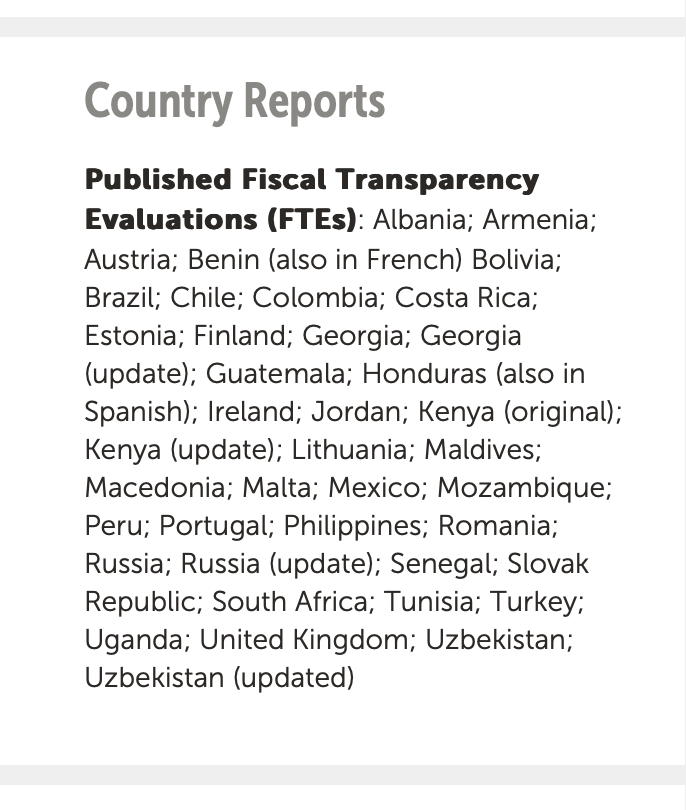
- Objectives: The FTE assesses IMF member countries’ fiscal (i.e. budget) transparency practices against the IMF’s Fiscal Transparency Code. It provides a comprehensive evaluation of fiscal transparency, highlights areas of vulnerability, offers visual heatmaps for benchmarking, and provides recommendations for reform.
- Methodology: The FTE evaluates a country’s fiscal transparency based on four pillars: fiscal reporting, forecasting, risk analysis, and resource revenue management. It categorizes practices into basic, good, and advanced, offering a sequenced path for reform.
- Uses and Access: FTEs guide governments in improving fiscal transparency and prioritizing reforms. The evaluations support capacity building and inform the delivery of IMF technical assistance. The FTE methodology is outlined in the IMF’s Fiscal Transparency Handbook, with published reports available on the IMF website. Countries may request non-disclosure of their assessment.
- Search for the latest FTE for your country:
- Click on the latest FTE assessment to know how your country performed.
- On the left-hand side, under the header labelled “Country Reports”, please press on your country’s name for the most recent FTE.
Debt Management Performance Assessment (DeMPA):
- Objectives: DeMPA serves as a benchmarking tool to assess government debt management performance and inform capacity-building efforts. It focuses on areas like governance, borrowing, cash management, and debt recording.
- Methodology: The assessment used 14 performance indicators across five categories. Each indicator is rated on a 4-point scale (A, B, C, D), with ‘A’ denoting sound practice. The methodology includes sovereign and subnational evaluations, offering a structured framework without specific recommendations.
- Uses and Access: DeMPA helps governments identify priorities for improving debt management, informs the design of reform plans, and promotes donor harmonization. It serves as a baseline for Sustainable Development Financing Policy (IDA-19).The methodology and reports are available on the World Bank’s website. Governments control the publication of their DeMPA results, with published reports being accessible.
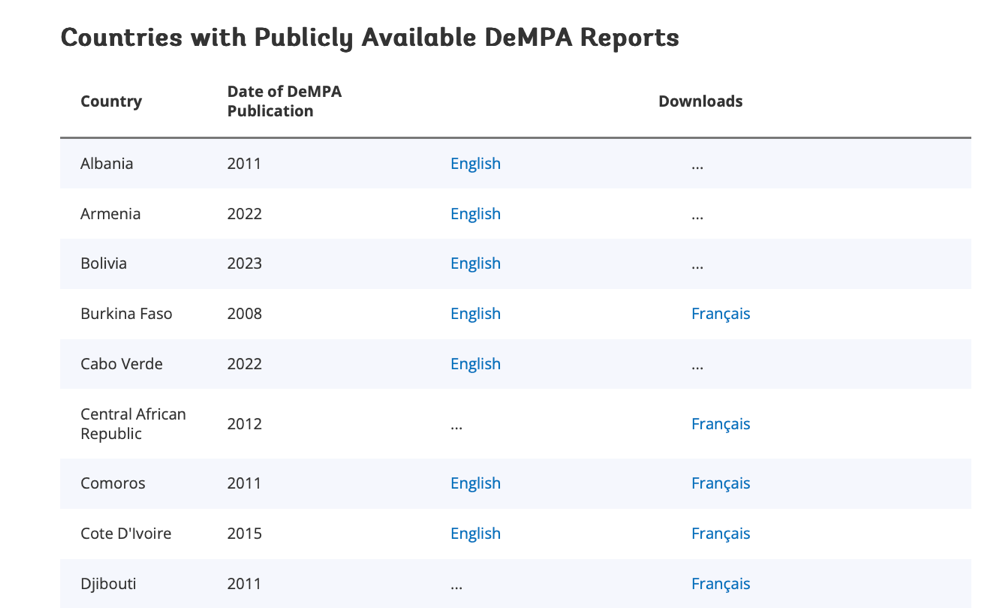
- Search for the latest DeMPA for your country:
- https://www.worldbank.org/en/programs/debt-toolkit/dempa
- Under the header labelled “Countries with Publicly Available DeMPA Reports”, please locate your country and click on the language you would like to download the report in:
Debt Transparency Heat Map:
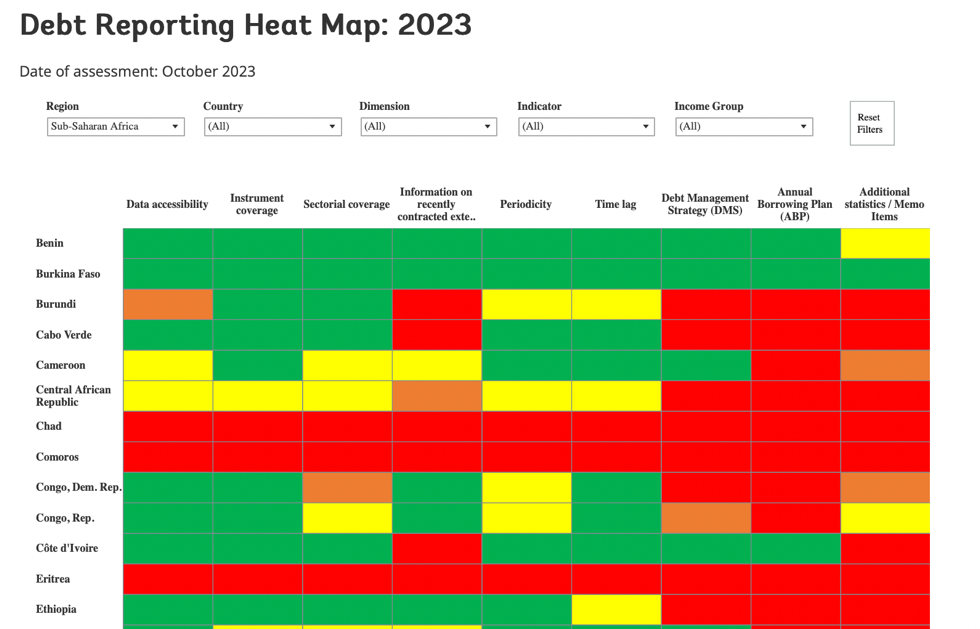
- According to the World Bank, the Public Debt Transparency Heat Map assesses public debt dissemination practices in International Development Association (IDA) countries, including:
- Public debt statistics dissemination practices; and
- Publication of key debt management reports; and
- Publication of other countries’ relevant debt data, including contingent liabilities.
- The heat map assesses whether the public debt statistics that are circulated are complete and provided in a timely manner, whether key public debt management documents are publicly available, and whether the government reports on all or just some contingent liabilities.
- (World Bank, 2023).
Indicators:
- Data Accessibility: Centralized public access to debt information is crucial for effective parliamentary oversight. The risk is that parliamentarians may lack access to necessary documents if information is dispersed or not tabled in parliament.
- Instrument & Sectoral Coverage: Comprehensive debt reporting should cover both external/domestic debt and guarantees, as well as debts from subnational governments and public corporations. Missing this data leaves parliamentarians unaware of significant debt drivers and risks.
- Reporting Frequency & Timeliness: Regular (biannual/quarterly) updates and recent data (less than three months old) are needed for parliamentarians to effectively participate in debt scrutiny. Delayed reporting limits their ability to act in time.
- Debt Management & Borrowing Plans: Annual debt management strategies and borrowing plans should include detailed targets and be available before the fiscal year. Without this, parliamentarians cannot assess government borrowing intentions or risks beforehand.
- Search for the latest Debt Transparency Heat Map Assessment for your country:
- https://www.worldbank.org/en/topic/debt/brief/debt-transparency-report/2023
- Scroll to locate your country and review the scores to gain a clearer understanding of its overall performance.
Objectives, Methodology, and Uses and Access for the Debt Reporting Heat Map are taken from the World Bank. https://www.worldbank.org/en/topic/debt/brief/debt-transparency-report/2023
Bulleted List of Key Points:
- PEFA (Public Expenditure and Financial Accountability): Assesses the condition of country public expenditure, procurement, and financial accountability systems.
- OBS (Open Budget Survey): Evaluates whether governments give the public access to budget information and opportunities to participate in the budget process.
- DeMPA (Debt Management Performance Assessment): Provides a comprehensive evaluation of the strengths and weaknesses in government debt management.
- World Bank Debt Transparency Heat Map: Assesses public debt reporting practices in International Development Association (IDA) countries, focusing on the accessibility, timeliness, and completeness of public debt information and key debt management reports.
-
November 5, 2024
Oui le dernier projet de budget exécutif (EBP) pour le Cameroun .La loi de finances initiale 2024 ou première loi de finances que le Parlement vote, est un acte juridique qui autorise le Gouvernement à percevoir les recettes et à engager les dépenses publiques pendant une année.
-les principales priorités mises en avant par le gouvernement pour l’exercice à venir
L’enveloppe du secteur Education est de 937,4 milliards de FCFA. C’est le secteur qui bénéficie de la deuxième importante enveloppe budgétaire. Le Ministère des Enseignements Secondaires pèse 57,5% de cette enveloppe, et celui de l’Education de Base, 30,9%.
Une enveloppe de 350,5 milliards de FCFA est allouée au secteur « Social » dont 255,3 milliards destinés au Ministère de la Santé Publique, soit 72,8% de l’enveloppe.
Le secteur « Infrastructures » demeure la priorité du Gouvernement. Le budget 2024 lui consacre une enveloppe de 1 168,2 milliards de FCFA, soit 17,5% du budget général. Le Ministère des Travaux Publics a la plus grande enveloppe, 569,2 milliards de FCFA (48,7% du budget du secteur).
Comment les organisations de la société civile (OSC) de votre pays peuvent-elles aider le parlement à analyser le dernier budget de l’UE .
la société civile joue un rôle de veille ou de surveillance fondamental dans la promotion de la responsabilité et la transparence au sein des gouvernements et des institutions. Les OSC contribuent à rendre le processus budgétaire plus transparent en analysant les documents budgétaires et en les rendant accessibles au grand public. Les OSC défendent les droits des citoyens et plaident pour des politiques équitables et inclusives. La Sensibilisation/ Elles informent le public sur les enjeux de la responsabilité gouvernementale, encourageant ainsi la participation citoyenne (consultation, concertation, collaboration) en éduquant et en facilitant la participation, les OSC contribuent à une gouvernance plus transparente et responsable, renforçant ainsi la démocratie et la justice sociale.
La source principale des informations que nous avons la la Loi de finances 2024 et la loi des règlement 2022. -
November 6, 2024
Yes. Priorities include i)Agricultural Transformation and Inclusive Growth; ii) Micro, Small and Medium Enterprise (MSME) Economy; iii) Housing and Settlement; iv) Healthcare; and v) Digital Superhighway and Creative Industry.
Giving feedback on whether the priorities set in the EBP are being met. i.e. secondary oversight
Kenyan Parliament Website -
November 6, 2024
Memoranda Submission and Public Participation forums
Submission of Memoranda and attending public participation forums
Time constraints to review and make submissions as well as complexity and bulkiness of information
Not really
-
November 9, 2024
Can you find the latest Executive Budget Proposal (EBP) for your country? What are the key priorities highlighted by the government for the upcoming fiscal year? (Hint: Look for areas such as health, education, infrastructure, or social services. How do these priorities align with the needs of the population?)
Answer: No
How can civil society organizations (CSOs) in your country support parliament in analyzing the latest EBP? (Hint: Think about how CSOs can provide research, data, or feedback to ensure that the budget reflects the needs and priorities of citizens.)
Answer: Through community response on budget allocation for specific areas as it relates to education, health and social services. In addition civil society can also support parliament with critical information on data collection and analysis on aspects of the budget that requires prompt intervention
What is primary the source of the information you provided?
Answer: Budget Advocacy Network (BAN)
-
November 9, 2024
Can you find the latest Executive Budget Proposal (EBP) for your country? What are the key priorities highlighted by the government for the upcoming fiscal year? (Hint: Look for areas such as health, education, infrastructure, or social services. How do these priorities align with the needs of the population?)
Answer: No
How can civil society organizations (CSOs) in your country support parliament in analyzing the latest EBP? (Hint: Think about how CSOs can provide research, data, or feedback to ensure that the budget reflects the needs and priorities of citizens.)
Answer: Through community response on budget allocation for specific areas as it relates to education, health and social services. In addition civil society can also support parliament with critical information on data collection and analysis on aspects of the budget that requires prompt intervention
What is primary the source of the information you provided?
Answer: Budget Advocacy Network (BAN)
-
November 9, 2024
In Kenya, the Executive Budget Proposal (EBP) is usually published by the National Treasury. You can access it on their official website, National Treasury of Kenya, where they post budget documents, including the Budget Policy Statement (BPS) and EBP, typically in the months leading up to the new fiscal year (beginning in July). Additionally, the Parliamentary Budget Office and the Controller of Budget also provide analysis and summaries of the proposal, which may be helpful in understanding its allocations and implications.
Facilitating of public participation and feedback. Research data and technical analysis.
-
November 9, 2024
Parliament mechanisms that have been established in Kenya is Submission of Memos and attending public participation forums.
Through the Okoa Uchumi coalition we have carried out extensive analysis on budget reports ,raised awareness for public participation and demanded for higher allocations to healthcare, education and agriculture by highlighting the struggles of Kenyans.
In Kenya, CSOs face challenges in the budget-making process due to limited access to timely information, restricted participation channels, and political resistance, with some officials perceiving CSO involvement as interference. Additionally, limited government responsiveness to feedback and the complexity of budget data make it harder for CSOs to contribute meaningfully to the process.
-
November 11, 2024
For Uganda, the key priorities highlighted by the government for the upcoming fiscal year 2024 /25 is “Full Monetisation of the Uganda’s Economy through Commercial Agriculture, Industrialisation, Expanding and Broadening Services, Digital Transformation and Market Access” It has been presented as a foundation for implementing the Government’s strategy for expanding the size of our GDP from about USD 50 billion in FY2022/23 to USD 500 billion by the year 2040.
I think that CSOs can make use of existing specialised networks on budget work like CS BAG to coherently research, package and engage Parliament to support parliament in analysing the latest EBP.
The primary the source of the information provided is from the Uganda Ministry of Finance, Planning and Economic Development
-
November 20, 2024
Compte tenu de contexte sécuritaire chez nous le gouvernement investi beaucoup dans la sécurité , dans les domaines tels que celui de la santé en réduisant les couts des des examens et actes médicaux de moitié la santé et la sécurité alimentaire
A travers l’analyse budgétaire qui permet à la société civile de dire au parlement le pourcentage budgétaire à loué à chaque secteur et poste des dépenses budgétaires.
Aussi leur relever les dépenses non nécessaires prévues dans la mesure où chaque modification propositions de modification du budget est conditionnée par la proposition des recettes devant couvrir cette dépense
En organisant des sessions budgétaires citoyennes les OSC recueillent les priorités des citoyens à la base
La synthèse des documents budgétaires et les conclusions des sessions citoyennes -
November 23, 2024
Zambia’s 2025 national budget reflects the impact of the recent challenges faced in the form of the worst Cholera outbreak and drought in recent years. Further it shows the impact of the debt restructuring agreement, with an increased nominal allocation towards key social sectors but an overall reduction as a percentage of the budget from 30% in 2024 to 24% in 2025. As a total for the allocation to critical areas such as health, education, social protection, and water, sanitation, and hygiene (WASH). This prioritization aligns with the government’s commitment to restoring fiscal health while addressing pressing developmental challenges.
In health, the budget increased to K23.17 billion, representing 10.7% of the total expenditure, a rise from K20.91 billion in 2024. Key initiatives include the recruitment of 2,000 health workers and the construction of 30 maternity annexes. Education saw a boost to K31.49 billion (14.5% of the budget down from 15.4% the previous year), up from K27.35 billion in 2024, with investments in building 120 secondary schools and 480 early childhood centers. Social protection received K16.16 billion (7.4%), focusing on programs like the Social Cash Transfer and Food Security Pack. The WASH sector received K2.99 billion, with a focus on constructing boreholes and piped water schemes, particularly in rural areas. But it is worth noting that this is only 1.1% of the budget and this has consistently been reducing since 2022 which was 1.8%.
These increases have been facilitated through better debt management and reallocations, although resource constraints remain a challenge. The debt restructuring agreement provided approximately $2.5 billion in cash flow relief, enabling the government to focus on critical sectors while adhering to IMF program targets. Despite these gains, the government must balance the need for fiscal discipline with sustaining social sector funding.
Therefore CSOs play a critical role in dissecting the budget and the numbers, making a clear distinction between norminal percentage changes as well as the implications of restructured debt in the context of resuming to make out payments towards debt servicing and what that means on the quantum of the budget. This advocacy and capacity building if continuous for members of parliament, parliamentary budget office and other stakeholders makes it possible for improved oversight. -
November 30, 2024
Agriculture, health, housing, employment
Provide platforms for expert analysis and unpacking
county website and national treasury
-
November 30, 2024
parliament invites submissions to be made and often they even target key organizations working on that issue.
we have submitted memos, held consultative meetings, and supported in policy formulation
Barriers to deepening collaboration
Parliamentary committees may lack the necessary expertise or resources to effectively scrutinize complex budget proposals, limiting their ability to engage meaningfully with stakeholders.
The political landscape can create tensions between the executive and legislative branches, making it challenging for parliament to assert its role in budget oversight effectively. Majority party dominance may also stifle constructive debate on budget issues
the legal framework governing budget processes may not empower parliament adequately to amend or influence budget decisions. This can lead to a perception of parliament as merely a rubber stamp for executive propos
Overcoming challenges.
Investing in training programs for parliamentary staff and members can improve their understanding of budget processes and enhance their ability to engage with stakeholders effectively -
December 2, 2024
CSOs play a significant role in ensuring that the budget processes and systems are transparent, open and participatory by coming up with independent analysis, deepening the budget debates and bringing in new information to the table
-
December 3, 2024
In your country what mechanisms has parliament established to facilitate civil society input into budget process?
Answer
– provide open interaction through budget formulation
– allow civil society engage in
monitoringIn what ways has my organization engaged with parliament on the budget?
Answer
– monitoring parliamentary work
– monitoring budget execution
-participating in sessions organized by parliament on the budget
– constant engagement with parliament on the budgetWhat are the barriers deepening and expanding CSOs and parliament collaboration
Answer
– lack of resources to effectively scrutize budget
– the legal framework which provides governance may unlikely empower parliament to implement budget decisions
– breakdown in communication between parliament and CSOs on budget formulation
What is needed to overcome it?
– bridge communication gap between civil society and parliament
– training opportunities for parliamentary staff and CSOs engaged in budget monitoringHave you provided input to other state institutions such as executive branch and SAI?
Answer
No -
December 4, 2024
Education, Infrastructure, Health, Public Debt and Fiscal Deficit, Revenue Mobilization. Education and Health align with the needs of the population but the rest don’t. Public debt and fiscal deficit have been prioritized over key sectors like agriculture and social programs
-
December 4, 2024
• In your country, what mechanisms has parliament established to facilitate civil society input into the budget process?
Pre-Budget Consultations, Public Participation Framework and the Parliamentary Committees hearings
• In what ways has your organization engaged with parliament on the budget?
Proposals through memoranda and oral submissions, public forums and media campaigns:
• What are the barriers to deepening and expanding this collaboration? What is needed to overcome them?
Political interference, lack of access to information , incomplete and very technical documents -
December 5, 2024
Can you find the latest Executive Budget Proposal (EBP) for your country? What are the key priorities highlighted by the government for the upcoming fiscal year?
Nigeria (my country) has 36 States. I have noticed that many States (for example, Anambra State) have made Education a priority where the Executive submits a budget for the Appropriation Bill which then becomes the Appropriation Law of a State when the Executive (the State Governor) assents to the bill. The Appropriation law in Nigeria is the law that approves and legitimises the National budget for the subsequent year.
-
December 5, 2024
Civil society organizations (CSOs) in Nigeria can play a crucial role in supporting parliament in analyzing the latest Executive Budget Proposal. Here are some ways they can contribute:
– Providing Technical Expertise: CSOs can offer technical expertise to parliament, helping them to understand complex budget details and identify potential issues.
– Analyzing Budget Documents: CSOs can analyze budget documents, identifying areas of concern, inconsistencies, and potential corruption risks.
– Conducting Public Hearings: CSOs can mobilize citizens to participate in public hearings, ensuring that their voices are heard and their concerns are addressed.
– Developing Alternative Budget Proposals: CSOs can develop alternative budget proposals, providing parliament with a more inclusive and equitable budget option.
– Promoting Transparency and Accountability: CSOs can promote transparency and accountability in the budget process, pushing for the publication of budget documents and the disclosure of budget information.
– Building Capacity: CSOs can build the capacity of parliamentarians, civil servants, and other stakeholders, enhancing their ability to analyze and understand budget documents.
– Fostering Collaboration: CSOs can foster collaboration between parliament, civil society, and other stakeholders, promoting a more inclusive and participatory budget process. -
December 7, 2024
Sierra Leone’s government has set priorities for fiscal year 2025, including strengthening the health sector, ensuring access to education, completing infrastructure projects, supporting agriculture, and scaling up social services.
These priorities align with the population’s needs and are crucial for the country’s development and well-being.
Civil society organizations can help analyze the Executive Budget Proposal by providing research, data, and feedback.
The Ministry of Finance’s Fiscal Strategy Statement outlines the government’s fiscal objectives and priorities for FY 2025-2027. -
January 10, 2025
Je ferai des recherches par rapport à ces questions, car en tant que jeune diplômée, j’ai pas d’information fiable sur les projets de budget exécutif
-
January 11, 2025
Yes, the latest Executive Budget Proposal for Mauritius for the fiscal year 2024-2025 is available. Key priorities highlighted by the government include health, education, infrastructure, and social services.
CSOs in Mauritius can support parliament by conducting independent analyses of budget allocations and their potential impact, offering evidence-based insights to inform parliamentary debates. Organizing forums to gather citizens’ feedback on the EBP, ensuring that diverse community voices are considered in the budgetary process. Offering training sessions to parliamentarians on budget analysis and public finance management, enhancing their ability to scrutinize the budget effectively. Tracking budget implementation and reporting discrepancies or inefficiencies, aiding parliament in its oversight functions. For instance, organizations like Transparency Mauritius have engaged in such activities, contributing to greater budget transparency and accountability.
The primary sources of information are official government publications, including the Ministry of Finance, Economic Planning and Development’s website, which provides access to budget documents and related reports.
-
January 28, 2025
Roads, education and healthcare are the major items budgetted for in my states budget.
-
February 6, 2025
CSO’s can support parliament in the budget process by active participation, advocacy for fiscal transparency and accountability.
They can scrutinize the budget and engage with the relevant stakeholders in Government throughout the process.
-
August 4, 2025
CSO’s can support parliament in the budget process by active participation, advocacy for fiscal transparency and accountability.
They can scrutinize the budget and engage with the relevant stakeholders in Government throughout the process.
-
August 4, 2025
Through community response on budget allocation for specific areas as it relates to education, health and social services. In addition civil society can also support parliament with critical information on data collection and analysis on aspects of the budget that requires prompt intervention
What is primary the source of the information you provided?
-
August 4, 2025
This section introduces key public finance management diagnostic tools that provide comprehensive assessments to support reform planning and monitoring. Each tool evaluates critical aspects of financial management, offering governments, civil society, and development partners the insights needed to drive transparency, accountability, and improvement in public financial systems. These tools include the PEFA, Open Budget Survey (OBS), IMF’s Fiscal Transparency Evaluation, DeMPA, and the Debt Transparency Heat Map each with unique methodologies and uses to guide reform efforts and enhance fiscal management across countries and Note: Objectives, Methodology, and Uses and Access for PEFA, OBS, FTE, and DeMPA are taken from PEFA’s 2023 “Stocktaking of Public Finance Management Diagnostic Tools”.
-
August 4, 2025
CSOs face challenges in the budget-making process due to limited access to timely information, restricted participation channels, and political resistance, with some officials perceiving CSO involvement as interference. Additionally, limited government responsiveness to feedback and the complexity of budget data make it harder for CSOs to contribute meaningfully to the process.
Leave a Reply