
SECTION 5.3 – MODULE 5 EXERCISE 1
Let’s get better acquainted with the Heat Map!
Instructions: The attached PDF contains an explanation of the individual indicators covered in the Debt Transparency Heat Map. You will want to open the PDF and access the Heat Map, which you can do by clicking here.
- Review the 9 Heat Map indicators.
- Using the attached PDF, get acquainted with the indicators, the good practice around each indicator, and the risk of not adopting that practice.
- Choose 2-3 indicators that are the most significant in your work and explain why.
- Now assess how your country rated on the actual Heat Map for these indicators in 2023. Was there any improvement/regression over time?
- Are there other countries in the region that scored higher in those indicators?
- How would you develop an advocacy campaign to strengthen debt transparency? Which stakeholders would you contact and what would be your key messages?
Your answers will be shared with the other e-course participants.
Upload your answers in the comment box provided below
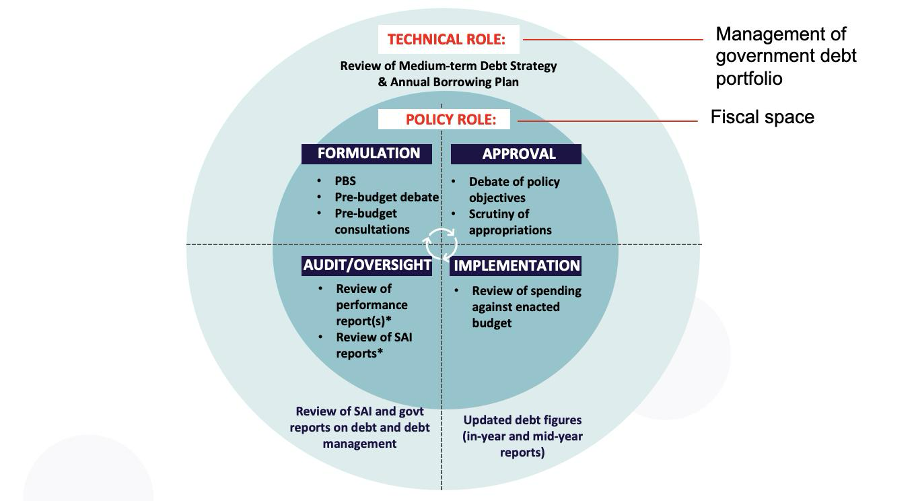
Overview of Scrutiny Role of Parliament in Budget Cycle and in Oversight of Public Debt:
This diagram explains the conversations that take place throughout the budget cycle over the allocation of resources, often in the context of limited fiscal space due to debt repayment. The outer ring refers to parliament’s role in reviewing key documents related to public debt throughout the budget cycle
(Dubrow: WFD, 2024

-
November 30, 2024 3:16 pm
Choose 2-3 indicators that are the most significant in your work and explain why.
• Data Accessibility is important to establish the volume of debt in different sectors in order to establish whether this is relevant to national priorities and aspirations. This is also important in the budget process as Parliament may want to know the resource gaps and expected borrowing to fill it
• Debt Management Strategy is important to know when, how and on what terms debts are to be taken on. This will enable parliament and CSOs to have a more critical oversight in use of the resources for what they are meant to achieveNow assess how your country rated on the actual Heat Map for these indicators in 2023. Was there any improvement/regression over time?
• On data accessibility, Uganda had a single document
• The DMS was also published with targets for domestic & external debt On the DMS
Are there other countries in the region that scored higher in those indicators?
• Yes there were more on data accessibility than DMS
How would you develop an advocacy campaign to strengthen debt transparency? Which stakeholders would you contact and what would be your key messages?
• The advocacy would be developed by highlighting indicators on Information on recently contracted external loans that is still N.A to be available, Other debt statistics / debt related contingent liabilities (CLs) for sufficient reporting of explicit CLs; and improvement in the time lag from > 6 months to < 3 months -
December 1, 2024 12:21 am
The goal of debt transparency advocacy is to increase awareness, push for legislative changes, and mobilize public support.
Key stakeholders include government officials, civil society organizations, international organizations, media, academia, and the general public.
Key messages emphasize the importance of transparency in holding governments accountable, addressing the impact on citizens, advocating for global standards, and promoting economic stability.
Strategies include public awareness campaigns, advocacy meetings, media engagement, petitions, and workshops.
The campaign’s progress is monitored through metrics like media coverage, public engagement, policy changes, and stakeholder feedback.
The campaign should be evaluated based on success and areas for improvement. -
December 5, 2024 12:47 pm
A. Choose 2-3 indicators that are the most significant in your work and explain why.
1. Information on recently contracted external loans – Knowing the details of external loans helps assess financial obligations, determine potential risks, and advise clients on compliance or restructuring strategies.
2. Data accessibility – With accessible data, legal teams can retrieve precedent cases, statutes, or client records promptly. This supports thorough analysis and robust legal advice, directly impacting outcomes and client satisfaction.B. Now assess how your country rated on the actual Heat Map for these indicators in 2023. Was there any improvement/regression over time?
On data accessibility, there was an improvement since in 2022 it was rated as partial. On the other hand, there is no change with respect to information on recently contracted loans, which remains as not available.C. Are there other countries in the region that scored higher in those indicators?
Niger and Mali are making great strides in Africa.D. How would you develop an advocacy campaign to strengthen debt transparency? Which stakeholders would you contact and what would be your key messages?
An advocacy campaign to strengthen debt transparency would focus on promoting accountability, economic stability, and policy reform. It would engage key stakeholders, including government bodies, international organizations like the World Bank, private sector lenders, civil society groups, and academia. The campaign would highlight how transparency reduces corruption, prevents financial mismanagement, and fosters public trust. Media outlets would amplify these messages, ensuring widespread public awareness and pressure on decision-makers. The ultimate goal is to establish transparent debt practices that benefit economies and societies alike. -
December 7, 2024 5:06 pm
3. Choisissez 2 ou 3 indicateurs qui sont les plus significatifs dans votre travail et expliquez pourquoi.
-. Informations sur les prêts externes récemment contractés – Connaître les détails des prêts externes permet d’évaluer les obligations financières, de déterminer les risques potentiels et de conseiller les clients sur les stratégies de conformité ou de restructuration.
-. Open Data/ Accessibilité des données est importante pour établir le volume de la dette dans différents secteurs afin de déterminer si cela est pertinent pour les priorités et aspirations nationales Grâce à des données accessibles, les équipes juridiques peuvent récupérer rapidement des cas précédents, des statuts ou des dossiers clients. Cela permet une analyse approfondie et des conseils juridiques solides, ce qui a un impact direct sur les résultats et la satisfaction des clients.
4- Évaluez maintenant le classement de votre pays sur la carte thermique actuelle pour ces indicateurs en 2023. Y a-t-il eu une amélioration/régression au fil du temps ?
Le cameroun n’a pas de données disponibles pour les emplacements spécifiés, cela peut être du a une erreur de recherche de ma part je peut l’avouer(-Y a-t-il d’autres pays de la région qui ont obtenu de meilleurs résultats dans ces indicateurs ?
Oui, il y en avait plus sur l’accessibilité des données que le DMS
6- Comment développeriez-vous une campagne de sensibilisation pour renforcer la transparence de la dette ? Quelles parties prenantes contacteriez-vous et quels seraient vos principaux messages ?
Développer une campagne de sensibilisation pour renforcer la transparence de la dette nécessite une approche stratégique et bien structurée:
– Définir les objectifs de la campagne: exemple i) Sensibiliser le public sur la transparence de la dette. ii) Eduquer sur les impacts de la dette publique; iii) Encourager la redevabilité du gouvernement et les institutions financières.
– Identifier le Public Cible/ i)Citoyens: Informer les électeurs sur l’importance de la transparence; ii)Décideurs politiques: Influencer les politiques publiques. iii) Organisations de la société civile: Collaborer avec les OSC/ ONG et les groupes communautaires.
– Développer un Message Clair: i) Créer un message simple et percutant, par exemple:” La transparence de la dette, c’est un droit!”. ii) Utiliser les données et des témoignages pour illustre l’importance de la transparence.
– Choisir les canaux de Communication: i) Médias sociaux; ii) Evènements en direct; iii) supports imprimés.
– Créer un contenu Engagé
– Mobiliser les partenariats: Collaborer avec les universités, des think tanks et des ONG pour élargir la campagne; ii) Impliquer les experts en finances publiques pour apporter crédibilité et expertise.
_ Mesure l’Impact: Evaluer l’efficacité de la campagne à travers des enquêtes et des analyses des médias, ii) Adapter la stratégie en fonction des retours et des résultats obtenus. -
December 8, 2024 6:12 pm
Choose 2-3 indicators that are the most significant in your work and explain why.
1. Data Accessibility :
Accessible debt data ensures transparency and accountability, allowing citizens, policymakers, and oversight institutions to scrutinize debt levels, terms, and repayment obligations. It supports informed decision-making by providing comprehensive and accurate data for crafting fiscal policies, assessing borrowing needs, and prioritizing projects. Regular publication of debt statistics helps monitor key indicators like debt-to-GDP ratio and debt service-to-revenue ratio, enabling timely interventions to prevent debt distress. Additionally, accessible data aligns Kenya with global standards set by the IMF and World Bank, enhancing international trust and cooperation2. Debt Management Strategy
Kenya has been under increasing scrutiny for its rising debt levels and dependence on high-interest commercial loans. An effective Debt Management Strategy (DMS) can alleviate these concerns by focusing on low-cost, long-term borrowing, ensuring that debt repayment obligations do not compromise essential services.
Now assess how your country rated on the actual Heat Map for these indicators in 2023. Was there any improvement/regression over time?
YesAre there other countries in the region that scored higher in those indicators?
YesHow would you develop an advocacy campaign to strengthen debt transparency? Which stakeholders would you contact and what would be your key messages?
I would ensure that the primary goal is to enhance transparency in public debt management by regularly publishing detailed debt data, clearly communicating debt terms, beneficiaries, and repayment plans, and providing public access to decision-making processes on borrowing.
The stakeholders would be the National Treasury, Auditor General, Controller of Budget, relevant Parliamentary Committees, CSOs, International Financial Institutions( IMF, World Bank), Economists, Academia and Media.
The messaging would focus on the need for transparency, Fight against corruption, Economic stability and public participation
-
December 9, 2024 9:27 pm
Module 5 Exercise 1
1. Review the 9 Heat Map indicators using the attached PDFAnswer
The heat map assesses the transparency of a.countru’s debt reporting practices. The heat map is based on the availability, competition and timeliness of data
3. Choose 2-3 indicators that are significant in your work and explain why.
Answer
I) Data Accessibility – to reveal the quantum of debt versus national priorities and aspirations
Ii) Data Management –
4. Now adsrdd how your country tatef on the actual heat map for these indicators on 2023. Was there any improvement/,repression over time?
Answer
My country Sierra Leone is rated on the heat map as follows:
Sierra Leone SSS 5-8-5 50th percentage . The map presents a combine annual maximize heat categorizations5. Are there other countries in the region that scored higher in these indicators
Answer
Yes
6. How would you develop an advocacy campaign to strengthen debt transparency?
Answer
I) Analyzing problem
Ii) Finding solutions
III) Identifying stakeholdersHow can we improve debt transparency for developing economies?
Answer
To improve debt transparency for developing economies we can :
I) strengthen legal frameworks – strengthen domestic legal frameworks for public debt
Ii) standardize clauses – standardize clauses in public debt
III) improve reporting – improve the speed and detail of their debt reporting
iv) improve cooperation+ improve cooperation from creditors through practical technical solutions
v) support capacity development – support capacity development in debtor countries through technical assistance
vi) foster clarity – foster clarity on financing arrangements and contracts
vii) ensure data consistency – ensure data consistency between creditor and debtor records
viii) disclose financing – publicly disclose financing provided by the private sector
ix) analyse debt records + analyse and report on debt trends of sovereign borrowing needs and Implications
x) publish debt data – publish debt data and information about borrowing processes.
xi)make information accessible ,- make information publicly accessible and shield it from political interference. -
December 12, 2024 4:21 pm
The goal of debt transparency advocacy is to increase awareness, push for legislative changes, and mobilize public support.
Key stakeholders include government officials, civil society organizations, international organizations, media, academia, and the general public.
Key messages emphasize the importance of transparency in holding governments accountable, addressing the impact on citizens, advocating for global standards, and promoting economic stability.
Strategies include public awareness campaigns, advocacy meetings, media engagement, petitions, and workshops.
The campaign’s progress is monitored through metrics like media coverage, public engagement, policy changes, and stakeholder feedback.
The campaign should be evaluated based on success and areas for improvement.Daisy Biwot December 5, 2024Reply
A. Choose 2-3 indicators that are the most significant in your work and explain why.
1. Information on recently contracted external loans – Knowing the details of external loans helps assess financial obligations, determine potential risks, and advise clients on compliance or restructuring strategies.
2. Data accessibility – With accessible data, legal teams can retrieve previous cases, statutes, or client records promptly. This supports thorough analysis and robust legal advice, directly impacting outcomes and client satisfaction.B. Now assess how your country rated on the actual Heat Map for these indicators in 2023. Was there any improvement/regression over time?
On data accessibility, there was an improvement since in 2022 it was rated as partial. On the other hand, there is no change with respect to information on recently contracted loans, which remains as not available.C. Are there other countries in the region that scored higher in those indicators?
Niger and Mali are making great strides in Africa.D. How would you develop an advocacy campaign to strengthen debt transparency? Which stakeholders would you contact and what would be your key messages?
An advocacy campaign to strengthen debt transparency would focus on promoting accountability, economic stability, and policy reform. It would engage key stakeholders, including government bodies, international organizations like the World Bank, private sector lenders, civil society groups, and academia. The campaign would highlight how transparency reduces corruption, prevents financial mismanagement, and fosters public trust. Media outlets would amplify these messages, ensuring widespread public awareness and pressure on decision-makers. The ultimate goal is to establish transparent debt practices that benefit economies and societies alike.NKE Joseph Anicet December 7, 2024Reply
3. Choisissez 2 ou 3 indicateurs qui sont les plus significatifs dans votre travail et expliquez pourquoi.
-. Informations sur les prêts externes récemment contractés – Connaître les détails des prêts externes permet d’évaluer les obligations financières, de déterminer les risques potentiels et de conseiller les clients sur les stratégies de conformité ou de restructuration.
-. Open Data/ Accessibilité des données est importante pour établir le volume de la dette dans différents secteurs afin de déterminer si cela est pertinent pour les priorités et aspirations nationales Grâce à des données accessibles, les équipes juridiques peuvent récupérer rapidement des cas précédents, des statuts ou des dossiers clients. Cela permet une analyse approfondie et des conseils juridiques solides, ce qui a un impact direct sur les résultats et la satisfaction des clients.
4- Évaluez maintenant le classement de votre pays sur la carte thermique actuelle pour ces indicateurs en 2023. Y a-t-il eu une amélioration/régression au fil du temps ?
Le cameroun n’a pas de données disponibles pour les emplacements spécifiés, cela peut être du a une erreur de recherche de ma part je peut l’avouer(-Y a-t-il d’autres pays de la région qui ont obtenu de meilleurs résultats dans ces indicateurs ?
Oui, il y en avait plus sur l’accessibilité des données que le DMS
6- Comment développeriez-vous une campagne de sensibilisation pour renforcer la transparence de la dette ? Quelles parties prenantes contacteriez-vous et quels seraient vos principaux messages ?
Développer une campagne de sensibilisation pour renforcer la transparence de la dette nécessite une approche stratégique et bien structurée:
– Définir les objectifs de la campagne: exemple i) Sensibiliser le public sur la transparence de la dette. ii) Eduquer sur les impacts de la dette publique; iii) Encourager la redevabilité du gouvernement et les institutions financières.
– Identifier le Public Cible/ i)Citoyens: Informer les électeurs sur l’importance de la transparence; ii)Décideurs politiques: Influencer les politiques publiques. iii) Organisations de la société civile: Collaborer avec les OSC/ ONG et les groupes communautaires.
– Développer un Message Clair: i) Créer un message simple et percutant, par exemple:” La transparence de la dette, c’est un droit!”. ii) Utiliser les données et des témoignages pour illustre l’importance de la transparence.
– Choisir les canaux de Communication: i) Médias sociaux; ii) Evènements en direct; iii) supports imprimés.
– Créer un contenu Engagé
– Mobiliser les partenariats: Collaborer avec les universités, des think tanks et des ONG pour élargir la campagne; ii) Impliquer les experts en finances publiques pour apporter crédibilité et expertise.
_ Mesure l’Impact: Evaluer l’efficacité de la campagne à travers des enquêtes et des analyses des médias, ii) Adapter la stratégie en fonction des retours et des résultats obtenus.Wangechi December 8, 2024Reply
Choose 2-3 indicators that are the most significant in your work and explain why.1. Data Accessibility :
Accessible debt data ensures transparency and accountability, allowing citizens, policymakers, and oversight institutions to scrutinize debt levels, terms, and repayment obligations. It supports informed decision-making by providing comprehensive and accurate data for crafting fiscal policies, assessing borrowing needs, and prioritizing projects. Regular publication of debt statistics helps monitor key indicators like debt-to-GDP ratio and debt service-to-revenue ratio, enabling timely interventions to prevent debt distress. Additionally, accessible data aligns Kenya with global standards set by the IMF and World Bank, enhancing international trust and cooperation2. Debt Management Strategy
Kenya has been under increasing scrutiny for its rising debt levels and dependence on high-interest commercial loans. An effective Debt Management Strategy (DMS) can alleviate these concerns by focusing on low-cost, long-term borrowing, ensuring that debt repayment obligations do not compromise essential services.
Now assess how your country rated on the actual Heat Map for these indicators in 2023. Was there any improvement/regression over time?
YesAre there other countries in the region that scored higher in those indicators?
YesHow would you develop an advocacy campaign to strengthen debt transparency? Which stakeholders would you contact and what would be your key messages?
I would ensure that the primary goal is to enhance transparency in public debt management by regularly publishing detailed debt data, clearly communicating debt terms, beneficiaries, and repayment plans, and providing public access to decision-making processes on borrowing.
The stakeholders would be the National Treasury, Auditor General, Controller of Budget, relevant Parliamentary Committees, CSOs, International Financial Institutions( IMF, World Bank), Economists, Academia and Media.
The messaging would focus on the need for transparency, Fight against corruption, Economic stability and public participation
John Koroma December 9, 2024Reply
Module 5 Exercise 1
1. Review the 9 Heat Map indicators using the attached PDFAnswer
The heat map assesses the transparency of a.countru’s debt reporting practices. The heat map is based on the availability, competition and timeliness of data
3. Choose 2-3 indicators that are significant in your work and explain why.
Answer
I) Data Accessibility – to reveal the quantum of debt versus national priorities and aspirations
Ii) Data Management –
4. Now adsrdd how your country tatef on the actual heat map for these indicators on 2023. Was there any improvement/,repression over time?
Answer
My country Sierra Leone is rated on the heat map as follows:
Sierra Leone SSS 5-8-5 50th percentage . The map presents a combine annual maximize heat categorizations5. Are there other countries in the region that scored higher in these indicators
Answer
Yes
6. How would you develop an advocacy campaign to strengthen debt transparency?
Answer
I) Analyzing problem
Ii) Finding solutions
III) Identifying stakeholdersHow can we improve debt transparency for developing economies?
Answer
To improve debt transparency for developing economies we can:
I) strengthen legal frameworks – strengthen domestic legal frameworks for public debt
Ii) standardize clauses – standardize clauses in public debt
III) improve reporting – improve the speed and detail of their debt reporting
iv) improve cooperation+ improve cooperation from creditors through practical technical solutions
v) support capacity development – support capacity development in debtor countries through technical assistance
vi) foster clarity – foster clarity on financing arrangements and contracts
vii) ensure data consistency – ensure data consistency between creditor and debtor records
viii) disclose financing – publicly disclose financing provided by the private sector
ix) analyze debt records + analysis and report on debt trends of sovereign borrowing needs and Implications
x) publish debt data – publish debt data and information about borrowing processes.
xi) make information accessible,- make information publicly accessible and shield it from political interference. -
December 19, 2024 9:10 pm
Passez en revue les 9 indicateurs de la carte thermique.
trême pauvreté ,Pauvreté multidimensionnelle, Climat, Genre, Dette, Croissance, Prix des produits de base ,Préparation des affaires, Lacunes dans les données, Regard vers l’avenirÀ l’aide du PDF ci-joint, familiarisez-vous avec les indicateurs, les bonnes pratiques autour de chaque indicateur et le risque de ne pas adopter cette pratique.
trême pauvreté ,Pauvreté multidimensionnelle( lutte contre les pauvretés), Climat Adaptation), Genre(inclusions), Dette(justice de la dette), Croissance(creation des richesse et une meilleure distribution des revenus crées), Prix des produits de base(résilience) ,Préparation des affaires, Lacunes dans les données, Regard vers l’avenirChoisissez 2-3 indicateurs qui sont les plus significatifs dans votre travail et expliquez pourquoi.
Regard vers l’avenir, le genre et Croissance
Évaluez maintenant la position de votre pays sur la carte thermique réelle pour ces indicateurs en 2023. Y at-il eu une/régression au fil du temps ?
Y at-il d’autres pays de la région qui ont obtenu de meilleurs résultats dans ces indicateurs ?
Comment développeriez-vous une campagne de plaidoyer pour renforcer la transparence de la dette ? Quelles parties entreront en contact avec vous et quels seraient vos messages clés ?


Leave a Reply