
SECTION 5.2 – OVERVIEW OF THE DEBT MANAGEMENT UNIVERSE
Overview: This section we will explore the interconnected relationships within the debt management ecosystem. Understanding these relationships is crucial for effective public debt management and for the roles that various institutions play in ensuring fiscal responsibility and transparency.
- Interrelationships in the Debt Management Universe:
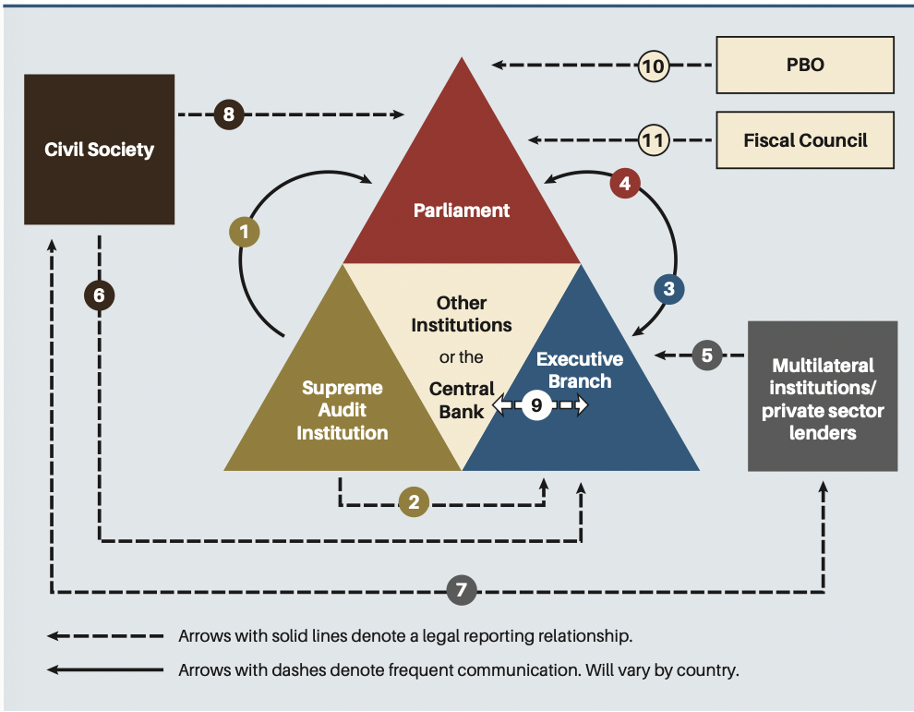
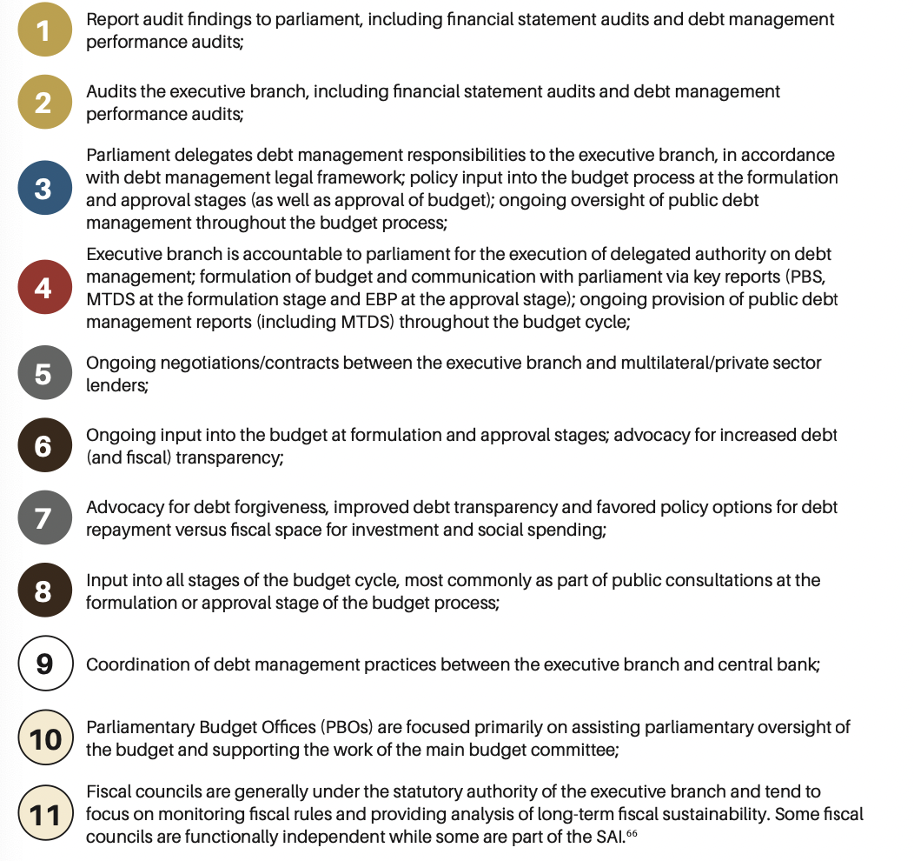
- The diagram illustrates the interrelationships in the debt management universe, highlighting the key actors and their interactions in managing public debt. The arrows with solid lines denote a legal reporting relationship, while arrows with dashes denote frequent communication, which will vary by country.
Ministry of Finance (MoF):
- The executive branch, typically led by the MoF is typically empowered with borrowing authority on behalf of the government, overseeing the debt structure and management strategy while ensuring debt sustainability through continuous monitoring (Dubrow, WFD/NDI 2022).
- A debt management unit (DMU), typically part of the MoF and staffed by public servants, is responsible for implementing debt management strategies, providing advice on cost-risk trade-offs, and adhering to international best practices by segregating duties to maintain control and protective measures throughout the transaction lifecycle (Dubrow, WFD/NDI 2022).
Central Bank:
- The central bank, primarily responsible for monetary policy, plays an active role in sovereign debt markets by selling debt securities to finance asset purchases, such as foreign exchange reserves, and may also be appointed by the government as an auction agent to issue new debt (Dubrow, WFD/NDI 2022).
- Although its main focus is not debt management, the central bank often intervenes when inflation increases, which can be triggered by rising domestic debt, and works closely with debt management units to address unanticipated fiscal changes or crises (Dubrow, WFD/NDI 2022).
Supreme Audit Institution (SAI):
- The SAI plays a key role in providing independent external oversight of public debt management by auditing the government’s consolidated financial statements, ensuring compliance with rules and regulations, and conducting value-for-money audits, with its findings publicly reported and reviewed by parliament to hold the government accountable for the management of public funds (Dubrow, 2022).
Fiscal Councils:
- Fiscal councils, typically independent institutions under the statutory authority of the executive branch, focus on monitoring fiscal rules and providing analysis of long-term sustainability, making them particularly valuable for countries at high risk of debt distress by ensuring compliance with fiscal and debt rules throughout the budget cycle, including ex-post monitoring that can support committees like the Public Accounts Committee (PAC) (Dubrow, 2022).
Parliamentary Budget Office (PBO):
- Parliamentary Budget Offices (PBOs) are independent public institutions with a mandate to critically assess and, in some cases, provide nonpartisan advice on fiscal policy and performance, offering valuable insights into government budgeting and financial management. PBOs are focused primarily on assisting parliamentary oversight of the budget and supporting the work of the main budget committee (Dubrow, 2022).
Civil Society Organizations (CSOs):
- Civil Society Organizations (CSOs) are independent groups that represent the interests of the public and play a crucial role in public debt management. They lead international debt relief initiatives, advocate for debt transparency and stronger parliamentary oversight, and work to strengthen debt management capabilities in low- and middle-income countries (Dubrow, 2022).
- Additionally, CSOs engage in public education campaigns, participate in parliamentary committees, and conduct citizen debt audits to ensure accountability and public participation in the management of public debt (Dubrow, 2022).
Private Sector Lenders:
- Private sector lenders, such as banks, have taken on a growing role in public debt arrangements due to increased access to international financial markets, with their share of external public and publicly guaranteed debt rising to 62% by 2015, often providing non-concessional loans at or near market terms, which can pose challenges for borrowing countries and require adherence to international lending standards to prevent predatory practices (Dubrow, 2022).
Multilateral Institutions:
- Multilateral Development Banks (MDBs), including the World Bank, IMF, and regional development banks, play a key role in providing concessional loans and grants to fund infrastructure and projects that support social and economic development, while also promoting improved debt management practices; however, low-income countries are increasingly shifting toward less concessional financing as the role of MDBs evolves in response to private sector developments.
7 Comments
Nous avons voir le rôle des acteurs dans la gestion de la dette
The debt management ecosystem is a complex network of interconnected relationships involving various actors and institutions. Here’s a breakdown of some key players and their roles:
Key Actors in the Debt Management Ecosystem
Governments: National governments are the primary borrowers in the debt management ecosystem. They issue sovereign debt to finance budget deficits and development projects.
International Financial Institutions (IFIs): Institutions like the International Monetary Fund (IMF) and the World Bank provide financial assistance and policy advice to countries, often influencing debt management strategies.
Credit Rating Agencies: Agencies such as Moody’s, Standard & Poor’s, and Fitch assess the creditworthiness of countries, affecting their ability to borrow and the terms of borrowing.
Commercial Banks and Investors: These entities purchase government bonds and other debt instruments, providing the necessary capital to governments.
Debt Management Offices (DMOs): These offices within governments are responsible for managing the country’s debt portfolio, ensuring sustainable borrowing practices.
Civil Society Organizations (CSOs): Organizations like AFRODAD advocate for responsible borrowing and debt relief, ensuring that debt management policies are aligned with development goals.
Supreme Audit Institutions (SAIs): These institutions, such as the Audit Service Sierra Leone (ASSL), audit government finances and ensure accountability in debt management.
Interconnected Relationships
Governments and IFIs: Governments often rely on IFIs for financial support and policy guidance, which can influence their debt management strategies.
Governments and Credit Rating Agencies: The credit ratings assigned by these agencies impact the borrowing costs and terms for governments.
Governments and Commercial Banks/Investors: Governments issue debt instruments that are purchased by commercial banks and investors, providing the necessary funds.
Governments and DMOs: DMOs work closely with governments to manage debt portfolios and ensure sustainable borrowing practices.
Governments and CSOs: CSOs engage with governments to advocate for responsible borrowing and debt relief, ensuring that debt management policies are aligned with development goals.
Governments and SAIs: SAIs audit government finances and ensure accountability in debt management, providing oversight and transparency.
Impact of Multilateral Institutions
Multilateral institutions like the IMF and World Bank play a significant role in the debt management ecosystem by providing financial assistance, policy advice, and technical support. Their involvement can influence debt management strategies, promote sustainable borrowing practices, and support economic development.
Enhancing Transparency and Inclusiveness
To enhance transparency and inclusiveness in the debt management ecosystem, it is essential to:
Increase Public Participation: Engage the public through consultations and hearings to gather input on debt management policies.
Publish Reports: Make audit reports and oversight findings publicly available to ensure transparency.
Strengthen Oversight: Ensure that parliamentary committees and SAIs have the resources and independence to scrutinize debt management practices effectively.
The interconnected relationships with debt management ecosystem is well brought out. The subsequent sections as highlighted are promising and I look forward to getting more insights.
very well put
The debt management ecosystem elucidates crucial relationship between the different actors and the zest for effective debt management. This module has aroused my interest to further delve into the subject of debt management and it’s impact on the average Sierra Leonean.
There is need for greater coordination for the institutions that manage public debt
Ce module est intéressant dans la mesure il donne des informations pertinentes pour m ‘engager plus sur la gestion de la dette publique.