
SECTION 5.1 – OVERVIEW OF PUBLIC DEBT
Overview:
In this section, we will explore the critical issues surrounding public debt, particularly in Africa. We will delve into the state of the debt crisis, the role of various actors such as AFRODAD, and the impact of multilateral institutions like the IMF and World Bank. We will also discuss demystifying public debt by looking beyond headline indicators and the importance of transparency in public debt management.

- Overview of the State of the Debt Crisis in Africa:
- Africa’s growing debt crisis has been fueled by a combination of economic shocks, political instability, and inadequate debt management. Many countries have increasingly relied on external borrowing in foreign currencies to finance development projects and budget deficits, which has contributed to a rapid rise in debt levels. This heavy debt burden has strained fiscal space, limiting the ability of governments to invest in critical sectors such as health, education, and infrastructure, as more resources are directed towards debt servicing.
- In addition to dwindling fiscal space, some African countries are at risk of debt default due to low foreign currency reserves and excessive foreign borrowing. As foreign debt obligations accumulate, the pressure to meet repayments becomes more challenging, especially in the context of volatile currency exchange rates and fluctuating commodity prices. This puts further strain on countries’ ability to manage debt effectively, exacerbating the overall debt crisis and threatening long-term financial stability.
- The COVID-19 pandemic further strained the financial resources of African countries, increasing their vulnerability to debt distress. As a result, the international community, including organizations such as the International Monetary Fund (IMF) and the World Bank, has been called upon to provide debt relief and support to mitigate the impact of the crisis.
- In Africa, according to the IMF, many countries are facing debt distress or are at high risk of debt distress.
- Countries currently in debt distress include: The Republic of Congo, Djibouti, Ethiopia, Ghana, Malawi, Sudan, Zambia, and Zimbabwe.
- Meanwhile, countries at high risk of debt distress include Burundi, Cameroon, the Central African Republic, Chad, and Comoros, The Gambia, Guinea-Bissau, Kenya, Mozambique, Sierra Leone, and South Sudan.
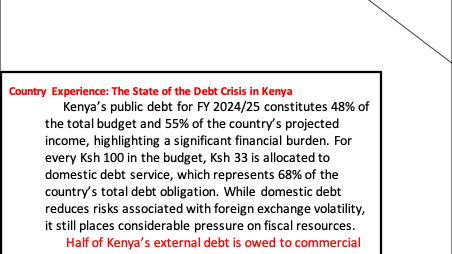
Example/Video on the State of the Debt Crisis in Africa:
1:58 – 4:12 Here is a clip from the Human Coined Podcast Ep. 24 “The Debt Crisis in Africa. Special Guest: Jason Braganza, Executive Director, AFRODAD.” In which Jason Braganza details the current state of the debt crisis in Africa, discussing whether it has improved or declined.
10:05 – 12:42 Here is a clip from the Human Coined Podcast Ep.24 “The Debt Crisis in Africa. Special Guest: Jason Braganza, Executive Director, AFRODAD.” In which Jason Braganza discusses the current state of the debt crisis in Africa regarding considerations for reform of the international financial, debt architecture, and debt cancellation.
20:14 – 28:51 Here is a clip from the Human Coined Podcast Ep. 30 (?) “The State of the Debt Crisis in Kenya. Special Guest: Diana Gichengo, Coordinator, Okoa Uchumi.” In which Diana Gichengo discusses the development of the debt crisis in Kenya, regarding how the crisis began and where it lies in current context.
2. Debt, Development and Economic Mismanagement:
- Strong parliamentary oversight is crucial for effective Public Debt Management (PDM), requiring alignment between the Constitution, PDM legislation, and parliamentary standing orders. While some constitutions address parliament’s role in debt management, it can also be established through legislation, which should mandate that key debt-related documents-such as borrowing, guarantees, and repayment are submitted to parliament for scrutiny by relevant committees, ensuring transparency and accountability.
- Parliamentary standing orders complement PDM laws by detailing committee responsibilities and procedures for public hearings and reports. Together, these frameworks enable robust oversight, fostering fiscal responsibility and accountability in debt management.
- Public debt plays a significant role in the development of African countries. It provides the necessary capital for infrastructure projects, social programs, and economic initiatives that drive growth and development. However, the mismanagement of debt can lead to adverse consequences, such as reduced fiscal space, increased debt servicing costs, the inability to deliver quality social services, and potential default.
- Mismanagement within PFM practices in Africa are a significant contributor to the escalating debt crisis. Key causes include weak internal control systems and insufficient internal and external audits. For instance, weak internal control systems often fail to detect or prevent unauthorized or inappropriate expenditures, while ineffective internal audits may overlook critical financial discrepancies. Moreover, opaque procurement processes, characterized by a lack of competition and transparency, can lead to inflated costs and increased opportunities for corruption.
- The issue of odious debt—debt incurred by regimes for purposes that do not serve the best interests of the nation, further complicates the debt landscape. Addressing this challenge requires an improved loan approval process based on predetermined criteria that ensure alignment with national development goals and ethical standards. By establishing strict criteria for loan approval, including comprehensive risk assessments, transparency requirements, and public interest evaluations, governments can prevent the accumulation of odious debt. This approach, coupled with strengthened internal control systems and robust internal audit practices, helps
- ensure that borrowed funds are used effectively and for their intended purposes, protecting future generations from being saddled with debt that was incurred irresponsibly or corruptly. Enhanced parliamentary oversight, combined with a rigorous and transparent loan approval process, is essential to safeguarding against the misuse of public funds and promoting sustainable economic development.
3. Debt and corruption:
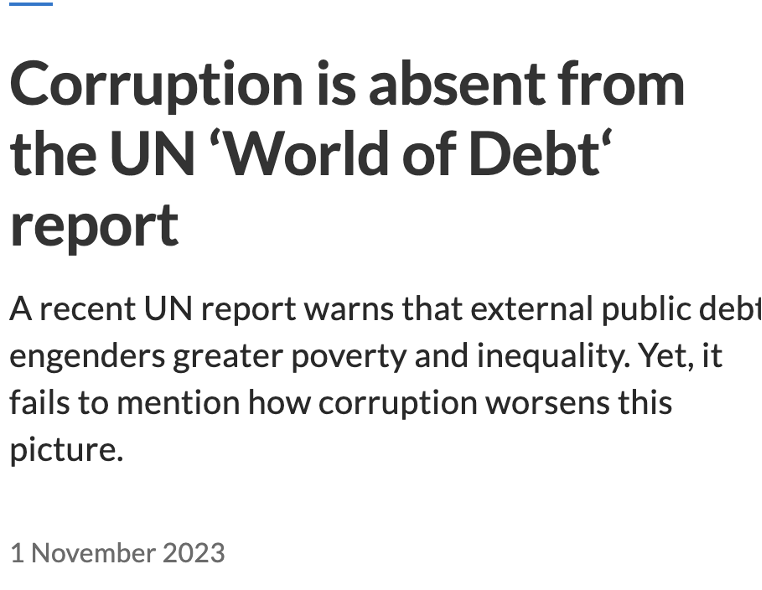
- Corruption, in the form of the misuse and theft of funds intended for economic development, exacerbates the debt burden for future generations.
- There is a direct and cyclical relationship between debt and corruption, particularly in low-income countries. Corruption exacerbates debt levels by diverting borrowed funds away from their intended developmental purposes, often into the pockets of corrupt officials or elites. This misuse of funds leads to inefficient projects or outright theft, which undermines economic growth and productivity, making it harder for countries to generate the revenue needed to service their debt.
- The resulting debt burden often necessitates further borrowing, creating a vicious cycle where new loans are also vulnerable to the same corrupt practices, deepening the financial crisis. Additionally, corruption erodes trust in governance, discouraging foreign investment and increasing borrowing costs, which further exacerbates the debt problem. Thus, debt and corruption are mutually reinforcing, with corruption inflating debt levels and unsustainable debt driving more corrupt practices as governments struggle to manage their fiscal situations. (TI US, Burkhart, 2024)
Example/Video Clip on the link between debt and corruption
30:00 – 36:00 Here is a clip from the Human Coined Podcast Ep. 31 (?) “Debt and Corruption. Special Guest: Annalise Burkhart, Research Associate, Transparency International US.” In which Annalise discusses the linkages between public debt and corruption.
9 Comments
La corruption sape tout effort de développement dans nos pays et expose les groupes marginalisés et vulnérable des gros risques sanitaire ,sécuritaire, d’analphabétisme et des famines
AFRODAD plays a crucial role in advocating for debt relief and sustainable development in Africa. They work to ensure that financial resources are allocated in a way that promotes gender equality and social inclusion. By pushing for debt relief, AFRODAD helps free up resources that can be invested in gender-responsive programs and policies.
International Monetary Fund (IMF)
The IMF has been increasingly focusing on gender-responsive budgeting (GRB). They advocate for the integration of gender perspectives into fiscal policies and budget processes1. The IMF’s work includes providing guidance and support to countries to help them implement GRB practices, which aim to promote gender equality and women’s empowerment.
World Bank
The World Bank also emphasizes the importance of gender-responsive budgeting. They support governments in integrating gender considerations into their budget processes to ensure that public spending benefits both men and women equally. The World Bank has developed various tools and frameworks to help countries assess and improve their gender budgeting practices.
Both the IMF and World Bank recognize that gender-responsive budgeting is not just about allocating funds but also about ensuring that these funds are used effectively to address gender disparities and promote inclusive development
I agree, corruption is a key contributor of debt crises in mot countries. I like how it is brought out in the context above.
Corruption and weak institutions like parliament and audit bodies are leading causes of the debt crisis in Africa.
Corruption and weak institutions encourage unserviceable debts and borrowing.
Corruption can be likened to cancer disease. If not dealt with appropriately it will destroy the fabric of society. Institutions like AFRODAD amongst others is a shinning example that tackles corruption for the wellbeing of all.
I agree, corruption is a key contributor of debt crises in mot countries. I like how it is brought out in the context above.
Corruption is a key contributor to unsustainable debt especially when you look at resource backed loans.
Corruption is a cancer eating away at very limited resources hence constricting an already suffocated fiscus